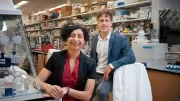
“Extraordinary opportunity but extraordinary fragility”—that’s how physician and researcher Katrina Armstrong, speaking at Harvard last week, described the state of medical research and healthcare in 2020 as the United States tipped into the cataclysm of COVID-19.
The fragility, she said, turned out to be greater than it seemed at the time.
Now the head of Columbia University’s Irving Medical Center, Armstrong spent nine years at Harvard—including during the pandemic—as chief of Massachusetts General Hospital’s medicine department and a professor at Harvard Medical School and the Chan School of Public Health.
She returned to the Chan School on December 8 to deliver a lecture on the “state of biomedical science.” In the final month of 2025, a year that shook the foundations of medicine and public health as the Trump administration scrapped decades-old healthcare policies and sought to strip billions in federal research funding from universities like Harvard and Columbia, Armstrong’s talk addressed an urgent question: “How did we get here, and what can we do?”
Her hour-long presentation mentioned U.S. President Donald Trump only twice, though, and not until nearly 40 minutes in. Instead, Armstrong focused on what she called “major forces” that weakened the field even before Trump’s second term began. Large-scale changes in recent decades have reshaped the partnership between universities and the government and undermined patients’ relationship to their healthcare providers, contributing to the loss of trust that took hold after the pandemic. And that loss of trust may have given Trump more leeway in his attacks on research universities and public health experts.
The federal government’s massive investment in research institutions, which began during World War II and accelerated rapidly thereafter—reaching some $60 billion by 2023—funded countless discoveries in medicine. But it also led to a dependence on outside money and an intense competition among universities for the best-funded senior faculty who could pull in large grants from the National Institutes of Health and other agencies. This competition also put a strain on individual researchers. “The pressure of getting those grants—and getting data to get those grants—was really extraordinary,” Armstrong said, adding that at some institutions, criteria for faculty promotion put the ability to win grants above the impact of a researcher’s work.
At the same time, another shift was underway, from a focus on basic scientific discovery to an emphasis on translating those discoveries into human health outcomes. “So, we created an entire field”—clinical and translational science—to try and achieve that goal, Armstrong said. “Not only do we have to understand how to study discovery to make sure it gets into clinical practice, but once we know how it works, then we are responsible for actually influencing that practice, changing the quality of the healthcare delivery.” Over time, this obligation propelled more scientists into the public square. One measure of that involvement: by 2019, as the country stood on the cusp of the pandemic, nearly 90 percent of scientists said they supported taking an active role in public policy debates, according to surveys by the American Association for the Advancement of Science.
As the biomedical research enterprise grew, it transformed healthcare, adding treatments and technologies that required new machines and buildings and other expensive infrastructure. “Healthcare has always been a capital-heavy enterprise, but it became extraordinarily capital-hungry,” Armstrong said. This drove a focus on “margin over mission,” as medical schools began to increasingly depend on money from the medical services in their academic hospitals. That emphasis on generating revenue pushed physicians to see more and more patients (and write more notes), which disrupted the physician-patient relationship. In 1996, Armstrong said, 62 percent of patients reported having an ongoing relationship with a personal physician; by 2018, that number was down to just over 50 percent. For older patients, the change was particularly noticeable: on average, people over 65 see their primary care doctor three times a year. Before 2000, Armstrong said, they tended to see the same person each time, but by 2019, they were more likely to see three different doctors at each visit to the same primary care practice. “And of course,” Armstrong added, “the impact on patients is also reflected in the impact on physicians”: in the 2000s and 2010s, burnout among doctors skyrocketed.
She described other forces, too: data collection on health disparities, launched in earnest in the 1980s, began to show the gaps in quality and access to treatment for different groups of Americans. Some improvements were made based on those data, though many more remain undone. When the pandemic hit, there was growing frustration in the medical community about the failure to fix root causes of inequality, Armstrong said, but also a feeling of opportunity.
And of course, she added, there’s the recent “explosion of information beyond anybody’s ability to manage it.” That means not only more scientific studies in a proliferating number of academic journals, but also expanded public access to all kinds of medical information. And at a time when patients are less connected to their personal doctors, they turn to the internet with medical questions—and, increasingly, to AI.
In the early days of the pandemic, biomedical science seemed strong: collaborations across medical fields spurred innovations in patient care and COVID-19 research. The vaccines appeared in less than a year. During those early months, Armstrong recalled, when uncertainty abounded, 46 percent of Americans said their trust in science went up.
But it didn’t last. COVID-19 variants brought renewed uncertainty, and Americans began to doubt scientists’ competence; and public health approaches varied drastically from state to state, from lockdowns to school closures to mask rules, creating a sense of chaos. Later, when it came to vaccine rollouts, Armstrong said, “chaotic is an understatement.” By the end of 2021, only 29 percent of American adults said they had a great deal of confidence in medical scientists. Trust in the federal government, perceived to be a leading driver of the pandemic effort, also took a hit. According to Pew surveys, it now stands at 18 percent, a near-historic low.
Where do scientists go from here? “I think we have to be realistic about how our country feels about the federal government,” Armstrong said, and acknowledge the profoundly negative effect the pandemic had on Americans’ (already sinking) view of higher education. “Across every group in this country, the belief in college education has dropped,” she said. That’s significant in a nation where the fundamental structure of scientific research is built on a collaboration between government and universities.
Armstrong’s first line of advice to counter all this was clear, but challenging: build back trust with patients and the public. That might mean opening the field up to new kinds of partnerships—with communities, with the private sector, with insurers focused on preventive medicine. And it will mean adjusting the healthcare industry’s incentives, she said.
At a basic level, she explained, trust depends on people’s belief in scientists’ competence and good values. It is also influenced by crisis. “We’ve learned that, paradoxically, uncertainty”—like in the early days of the pandemic—“facilitates trust. And anytime that, as scientists, we portray false certainty, we risk destroying that trust.” Perceived financial motives undermine trust as well, as do connections between scientists and politicians. Studies have shown that regulations and mandates damage trust, too. Rather than tell people what to do, “we need to tell people what we don’t know, and we need to be honest and authentic in how we do that,” Armstrong said. “I don’t have a simple answer.”