Texas Waves Hello

Harvardians journeying to the north side of San Antonio—the "Texas Hill Country"—may need only look skyward for a familiar...

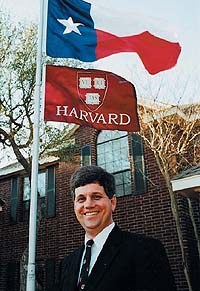
Harvardians journeying to the north side of San Antonio—the "Texas Hill Country"—may need only look skyward for a familiar sign. Crimson often flies atop a 25-foot pole at the home of John F. Kirk, the new HAA regional director for Texas and former president of the Harvard Club of San Antonio.
Jay and Cheryl Harris
Rose Lincoln / Harvard News Office

Harvard's flag is not the only one flown on a rotation. Kirk's collection includes the Union Jack and Dixie flags, as well as those of the U.S. Marines, Ireland, Massachusetts (his home state), and Taiwan (in honor of visits by his sister-in-law). "I was in the Boy Scouts, and always enjoyed flags," explains Kirk, who earned a certificate of special studies in administration and management from the Extension School in 1990. "I fly the Texas flag to commemorate the siege of the Alamo, and aput my flags at half-mast when you're supposed to and, in general, try to be a good patriot."

Harvard's colors fly whenever alumni friends drop in for a visit, and at Kirk's annual barbecue bash for club members and Harvard-bound students from the San Antonio area. Directions to the party are easy, he says: "Look for the Harvard flag, and you will know you are home."        

Most popular

What Trump Means for John Roberts’s Legacy

Executive power is on the docket at the Supreme Court.

Explore More From Current Issue

A lively concert in a modern auditorium with an audience seated on multiple levels.

Concerts and Carols at the Isabella Stewart Gardner Museum

Tuning into one of Boston's best chamber music halls 

Illustration of tiny doctors working inside a large nose against a turquoise background.

A Flu Vaccine That Actually Works

Next-gen vaccines delivered directly to the site of infection are far more effective than existing shots.

Map showing Uralic populations in Eurasia, highlighting regional distribution and historical sites.

The Origins of Europe’s Most Mysterious Languages

A small group of Siberian hunter-gatherers changed the way millions of Europeans speak today.