1915 One hundred-plus Harvard men and their families sail from New York City via the Panama Canal to San Francisco to attend the annual meeting of the Associated Harvard Clubs.
 |
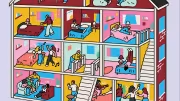
| Illustration by Mark Steele |
1920 Harvard faces a large deficit unless the Endowment Fund can raise the $3 million needed to reach its $15.25 million goal. The editors note reproachfully that only 59.4 percent of alumni have donated to date, a poor showing compared with participation rates at Princeton (76.7 percent) and at Smith (82 percent).
1930 In response to fears that President Lowell’s House plan would “subject the individual student unduly to the pressure of group-opinion,” the editors assert that the Harvard undergraduate is “a peculiarly intractable individualist…His most characteristic symptom is his insistence on exercising his own judgment, and his almost morbid suspicion of any form of organization…that may seem to subject him to mass pressure.”
1945 The Harvard Committee on the Objectives of a General Education in a Free Society issues its reportthe foundation of the College’s “Gen Ed” requirements, which last into the early 1980s.
President Conant announces at Commencement that an honorary degree was voted in January to war correspondent Ernie Pyle, who replied that he would treasure the offer but expected to be in the Pacific for a year or more “[u]nless I get sick or something happens….” (Pyle had been killed April 18.)
1960 The Ford Foundation gives Harvard $5.6 million “to put non-Western studies on a permanent, competitive footing with other subject matter” during the next 10 years.
1970 Construction begins on an undergraduate Science Center, a $17.6-million complex that is expected to take between 32 and 36 months to complete.
1980 The governor of Massachusetts signs a bill repealing Harvard’s exemption from Cambridge zoning laws. (The University had previously been protected by a passage in the Commonwealth’s 200-year-old constitution.)
1985 Several Law School students organize a candlelight rally at Memorial Hall in July to protest apartheid and Harvard’s ownership of stock in companies doing business in South Africa. President Bok, meanwhile, drafts a letterco-signed by 19 other university and college presidentsto congressional leaders endorsing economic sanctions against the South African government.