The HAA Clubs and SIGs (Shared Interest Groups) Committee Awards honor both individuals who provide exemplary service to those groups, and groups that have themselves organized exceptional programming. The following recipients were to be honored at the HAA Board of Directors’ winter meeting on February 6.
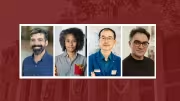
Rowena S. Frazer ’76, of Hoover, Alabama. Officially the program chair of the Harvard Club of Birmingham, Frazer is also known as “Bulldog” or “The Big Thinker” for transforming the club into a vibrant social, educational, and philanthropic outlet for alumni. She created the E.O. Wilson Distinguished Lecture Series to bring faculty members to Birmingham; raised money to enable an inner-city high school to compete at a Harvard tournament; and established the club’s Summer Community Service Fellowship, a largely alumni-funded program that helps undergraduates work in the public-interest sector.
Thomas P. Reardon ’68, of Plymouth, Massachusetts. Reardon founded the Harvard Veterans Alumni Organization SIG in 2007, and since then has, almost single-handedly, ensured its success by creating a board of directors, attracting more than 800 members, organizing social events, such as football tailgate parties, and raising the Harvard community’s awareness of veterans’ contributions. The SIG partnered with the Harvard Club of Washington, D.C., to establish the Memorial Church plaque dedicated to Harvard’s Medal of Honor recipients. Reardon has also spent hours readying HVAO’s AlumniMagnet website to ensure that the group has a strong and welcoming online presence.
Founded in 1886, the Harvard Club of Indiana has been revitalized within the past year under a new board of directors that has increased membership, updated the club’s website, and restored the budget. Moreover, a series of diverse events, such as a private tour of the Indiana Museum of Art, has drawn alumni from every decade since the 1950s, and club leaders have strengthened members’ ties to the University through hosting HAA-sponsored Global Networking Night events, sponsoring dinners for Harvard’s swim-team members when they were in town, and welcoming newly admitted regional students at a dinner and information session.
The Harvard Club of Japan holds nearly 40 events a year, ranging from lectures on international topics, to wine tastings, to monthly Zen meditation sessions. Its treasury has doubled to $60,000 within the last five years, and it has also successfully connected with other local alumni groups and clubs from graduate and professional schools across the University. The club hosted a historic dinner for President Drew Faust in Tokyo in 2010, and the HAA Asia-Pacific Club Leaders’ meeting in 2011. Club members have also rallied in providing aid to the Fukushima community.