During the tumultuous Trump presidency, Los Angeles Times legal affairs columnist and former U.S. attorney Harry P. Litman ’80 became a “talking head” on cable TV.
“Former prosecutors began to play the role that journalists maybe had played in Watergate,” he explained. “There was a lot of interest in their supposedly specialized knowledge.” Litman said news networks called on him to deliver 15-second answers to deeply involved legal questions.
After comparing notes, Litman and some fellow “talking heads” agreed that this soundbite format didn’t “do justice” to the issues or their complexity. That realization was the impetus for Litman to launch his star-studded podcast, “Talking Feds,” in spring 2019. The weekly show—which ranks in the top 1 percent of all podcasts—welcomes a rotating cast of expert guests to a lively roundtable, where they discuss legal-political issues in depth.
“We really hungered for a more dynamic, nuanced, maybe funny, maybe loose, kind of back-and-forth,” Litman said. “The conceit that I give to guests is we are in our favorite booth at Friday quitting time at the back of our favorite bar…You can interrupt each other and jump off each other and dispute each other.”
“It’s a marvelous operation,” said Loeb University Professor emeritus Laurence H. “Larry” Tribe ’62, G.S.A. ’63, J.D. ’66, who has thrice joined the podcast. Tribe specifically praised Litman’s “savvy”: “He knows how Washington works, he knows where the skeletons are buried, he knows what strings people pull in order to get things done,” he said. “It’s not just an abstract or theoretical discussion.”
The show got its start inviting a number of former federal prosecutors—the titular “feds”—to dissect the investigation by Special Counsel Robert S. Mueller III into Russia’s interference into the 2016 election probe and the possibility of collusion with the Trump campaign. According to Tribe, Litman “took Trump to task as president, but not from a purely partisan or just nasty point of view. He was focused on the harm that Trump did to the legal system and to democracy.”
“‘Talking Feds’ was essential during the Russian investigation,” adds five-time guest and CNN’s “Early Start” anchor Laura A. Jarrett, J.D. ’10. “[Litman] kept it relevant, even after that finished,” by figuring out “how to do something that not everyone else has been so successful in doing,” she said: “…how to pivot after the story wasn’t all about Donald Trump.”
As it has moved beyond its initial hook, the podcast’s guest list has expanded to include policy makers, civil servants, political thinkers, and journalists, in addition to the original “feds.” “I feel like the luckiest guy in the world in podcast land,” Litman said. “Week-in, week-out, we just have these killer sets of guests.”
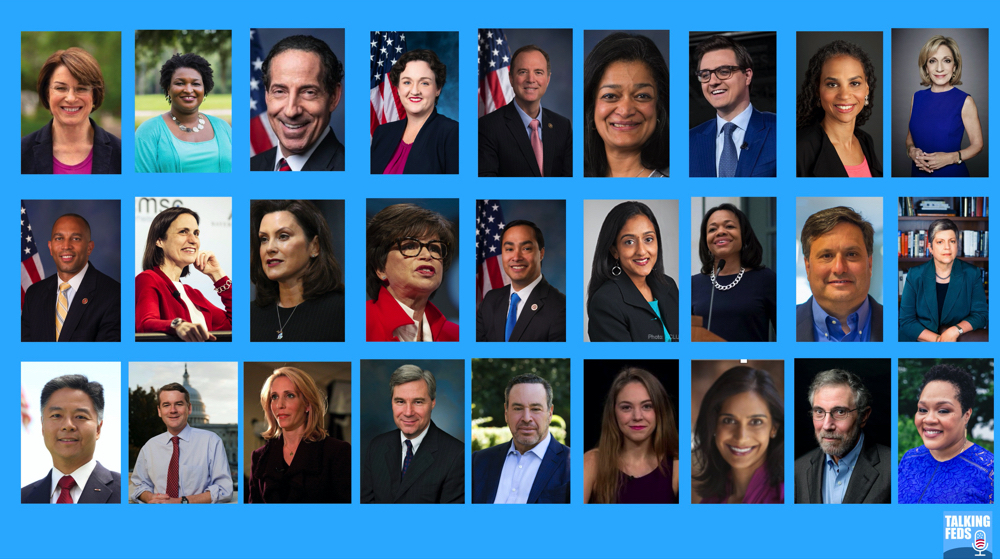
Guests on the podcast have ranged from Minnesota senator Amy Klobuchar to MSNBC anchor Chris Hayes.
Montage courtesy of Harry Litman
“You’re never in a rut of the same two people or three people,” said seven-time guest Juliette N. Kayyem ’91, J.D. ’95, who is a CNN national security analyst and Kennedy School lecturer. She specifically commended Litman for inviting on reporters, whom she described as invaluable and often overlooked “subject matter experts.”
Kayyem enjoyed participating on the podcast so much, in fact, that she teamed up with the legal scholar Melissa Murray and New Jersey’s former Attorney General Anne Milgram to host the spinoff series, “Talking Feds: Women at the Table.” Professionally, “We’re all on air. We do CNN or MSNBC, and we’re quoted,” Kayyem said. “[Women at the Table] is just sort of our way of completing our sentences.”
The show also welcomes celebrities like Cecily Strong and John Malkovich to narrate its “Sidebar” features—explanatory segments that lay the groundwork for understanding complex political-legal issues. “Robert De Niro explaining whether Trump can pardon himself?” Litman said, laughing. “It’s fun.”
On a podcast run by a Democrat, Republican guests may seem like even more of a novelty than celebrities. But Litman stresses that his show—whose thematic backbone is simply “good government and rule of law”—is bipartisan: “Always, a good Republican will round things out,” he said. “I will try to avoid propagandistic people on either side of the aisle…including some members of Congress who will just go in and give talking points.”
“Talking Feds” is expanding even further as the L.A. Times prepares a TV version of the podcast. At this transitional point, Litman is insistent upon maintaining creative control over what he describes as his “scrappy, little-engine-that-could operation.” Still, he said, he’s ready to elevate the podcast’s currently Twitter-based marketing: “I am now finally taking some time to think strategically about doing the things that other big podcasts do.”