In an affecting May 23 baccalaureate address to College seniors, President Lawrence S. Bacow recalled that in the fall of 2019, he had told this class at their freshman convocation that “Anyone who is thinking of the next four years as a series of stepping stones to a predetermined outcome is a person who will miss the point of this place.”
“As it turned out,” Bacow continued, speaking candidly to the soon-to-be-graduates, “‘anyone’ included me”—because the pandemic reordered every sort of assumption, everything he had taken for granted about his presidency. “In that turmoil,”—including the difficult decision in March 2020 to send these then-freshmen home—“I rediscovered the point of this place—and how very much it is the people who define the University—our students, our faculty, our staff.”
Bacow then shared with the seniors, including friends and family members seated behind them in Tercentenary Theatre, “the lessons that Harvard taught me [that] I wish to share…with you as you prepare for your graduation.”
“First,” he said, he had “learned that a career is only knowable in retrospect.” The path, in other words, is emphatically not prescribed or prescriptive. Looking back on the series of decisions, chance events, and support of others (from a mentor to his wife Adele Fleet Bacow) that shaped his own career, he said that it is only now that it “all makes sense.”
Second, he had learned that there is “no way that you can know everything. No matter what your position, whether you are in your first job or, like me, your last, it is OK to say, ‘I don’t know.’ And to do so is not a sign that you are weak; it is a sign that you are confident, that you have the confidence to seek out others who know more than you.”
During the pandemic, for instance, “I learned that I needed the advice and counsel of those who knew far more about the complexities of decisions that were…completely foreign to me. I knew nothing about infectious diseases, other than having had a few of them myself. I knew nothing about epidemiology, virology, or public health. Had I made important decisions without the benefit of counsel from those who are experts in these fields, I would have been guilty of presidential malpractice.”
But it requires “humility to know that you can never know everything. I would urge you to avail yourself of all the intelligent people at your disposal. As Ben Zoma said [and is quoted in the Talmud], the wise person learns from all people.”
Third, Bacow said, the Harvard presidency taught him “that it’s possible to never grow old…. One of the joys of spending your life on a college campus… is that while you may grow old, the people around you stay the same age. Being around young people actually helps to keep some of us young. I think there is no substitute for the clarity and the passion that exists…in this space right now. You are open to new ideas and to one another in ways that…some of us who are older are not. You’re free of constraints and obligations. You’re alive with possibility and outcome. Looking out at you, I see the future as it might one day be, and it gives me hope. I’m grateful to you—to every student I have ever wished well on the eve of Commencement—for helping to ensure that my eyes, my mind, and my heart are never closed to new ideas, new ways of seeing the world, and new possibilities.”
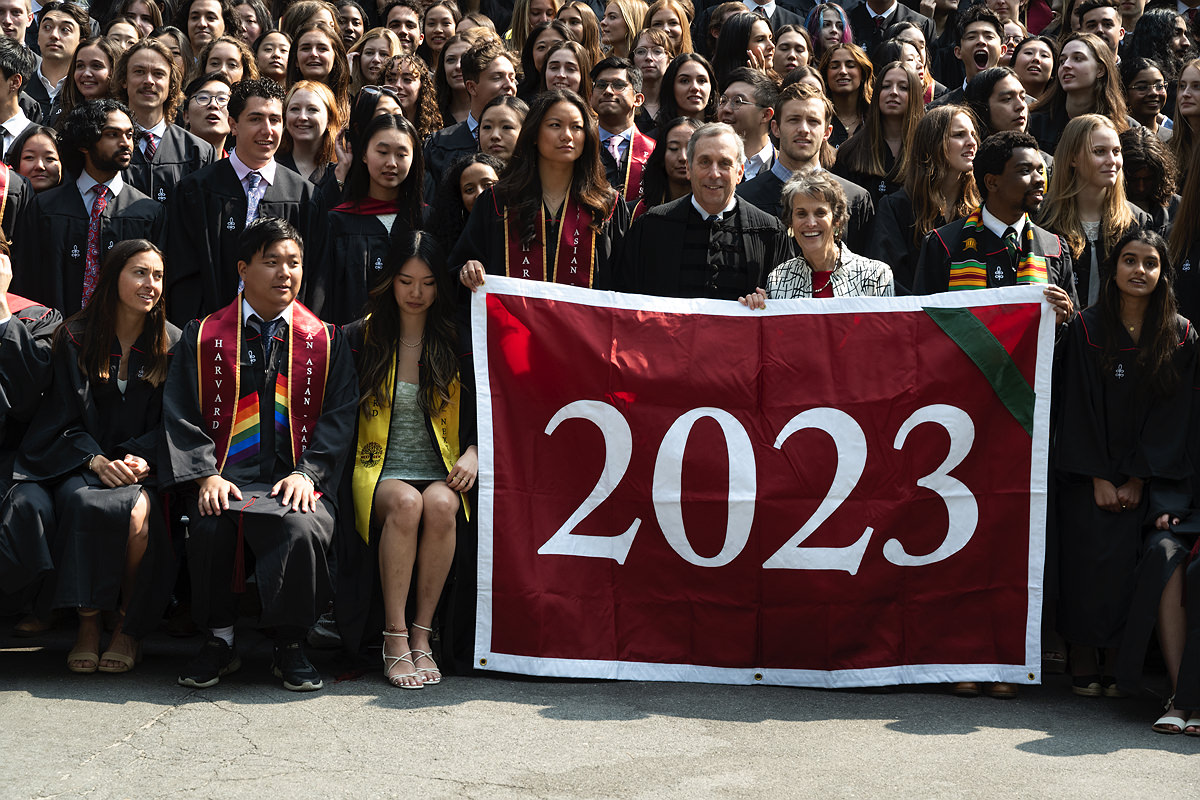
The president added some personal advice. Five years ago, then a semi-retired university president, someone suggested he consider “this job.” He had “looked in the mirror” and “did not see the president of Harvard.…I was not the image of what a Harvard president ought to be.” But his wife advised him otherwise. (“And here I’m going to go a little off script,” he added, “and offer you some unsolicited advice. When you look for a life partner, whoever that happens to be, make sure you find somebody who always brings out the best in you. I got that when I married Adele.”) “Now, it was this wisdom which she had imparted to me at many other points in my career…. So, once she said that, I actually stopped looking in the mirror, I got out of my own way, and here I am standing before you—giving you the last advice I will ever give to a Harvard College class again.”
“Nurture those… who have the capacity to speak to you in such important and fundamental ways. And if you do,” he concluded, “the stepping stones I referred to in my convocation speech…will appear wherever you direct your steps.”
Bacow closed with a benediction of sorts:
May you always be curious.
May you never stop learning.
May you be yourselves.
May you be more than yourselves.
And, as Bob Dylan wrote, may you be forever young.
“And if you do at least a few of these things, I have great confidence that you will make your mark on the world, that you will make your friends and your family and Harvard also proud of you.”
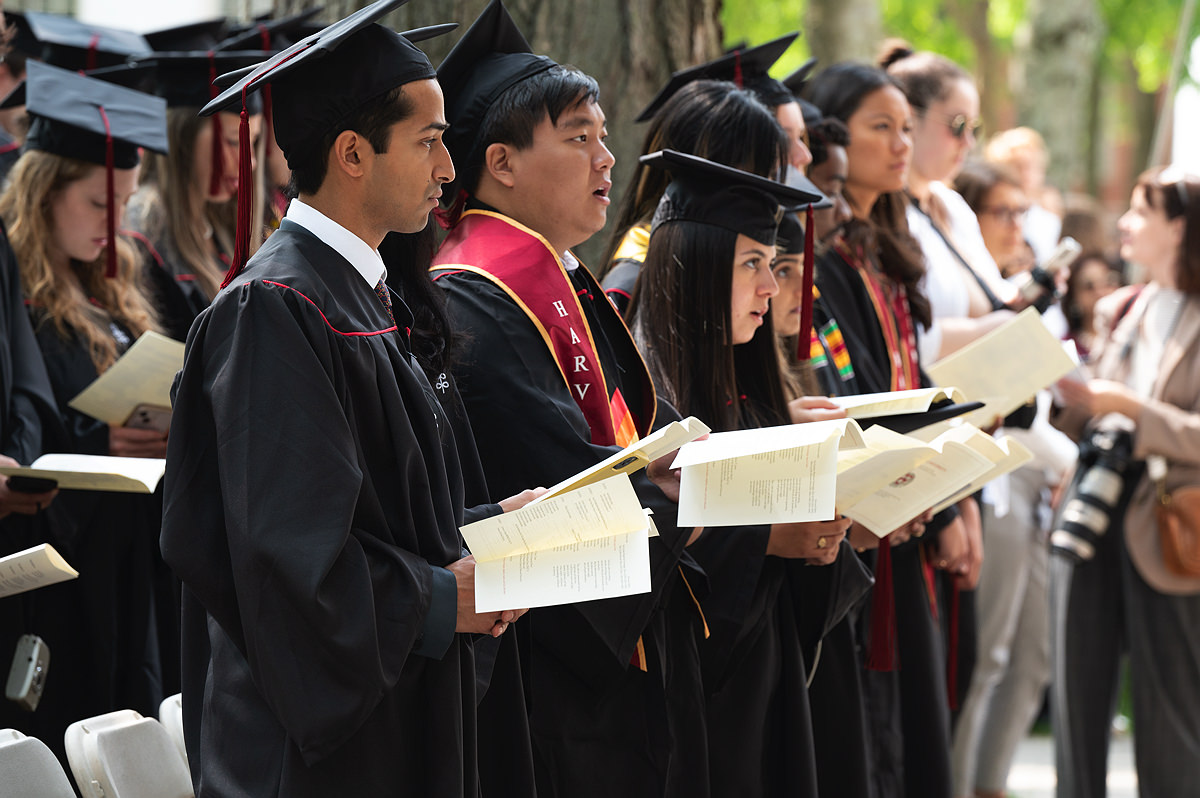
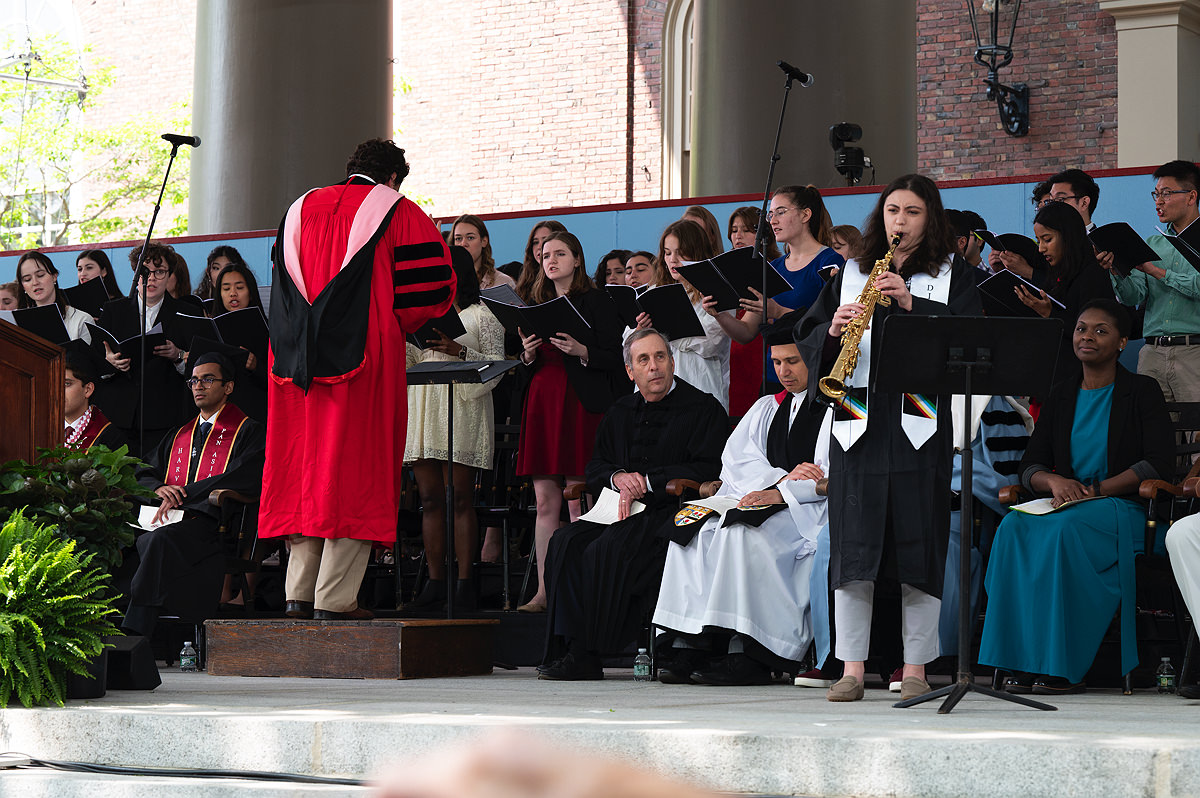
The Baccalaureate service, many elements of which hearken back to the religious origins of the earliest American colleges and universities, now includes readings by members of the senior class from Islam, Judaism, Buddhism, Christianity, and Hinduism, as well as the traditional singing of Psalm 78 to the tune “St. Martin’s,” an observance since at least 1806. This year the ceremony also included an anthem sung by the Commencement choir, “Hold Fast to Dreams,” the music by senior class member, composer, and soprano saxophone soloist Veronica Leahy ’23.
The full text of President Bacow’s Baccalaureate address appears here.