Around eight million years ago, some of our ancestors began the long evolutionary journey from walking on all fours to walking on two legs. Becoming bipedal set humans on a unique evolutionary path and paved the way for all that came after: sophisticated tools, larger brains, a better diet, and eventually farming, writing, and the myriad other innovations that have helped us dominate the planet. The shift to walking upright was made possible by the remodeling of the pelvis, which enabled our ancestors to stand and move in radically different ways.
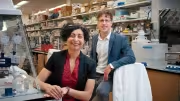
The broad outlines of this transformation have been known for decades: the human pelvis forms a basin (this is what “pelvis” means in Latin), allowing for our vertical orientation in space. But surprisingly, the details of this transformation have remained mysterious. Until now. Terence Capellini, a professor in the department of human evolutionary biology, has spent the past several years analyzing human pelvic evolution. This summer, he and postdoctoral fellow Gayani Senevirathne published a paper in Nature pinpointing key genetic and structural changes. “We’ve known that the human pelvis is unique, but how and why it develops that way has been a longstanding question,” Senevirathne says. “This study shows that the human pelvis grows and forms bone very differently from all other primates.”
Using MRI scans to analyze 128 samples of embryonic tissues from humans and more than 20 other primate species—many of them painstakingly tracked down at museums and research institutions around the world—the scientists made two main discoveries. One is that, as the human pelvis develops, it grows perpendicularly, which sets it apart from other primates. “It just grows in a completely different direction,” Capellini says. “When we saw that, we were really surprised. That was new.”
Another key change: instead of hardening after eight or 10 weeks of gestation, as most other large bones do, the human pelvis stays in cartilage form for another four months—which the researchers suspect allows it to form its unique shape. They also pinpointed more than 300 genes that play a role in these processes, including a gene known as SOX9, which is crucial to the cartilage growth process, and another gene, RUNX2, which is critical in bone ossification.
Capellini and others theorize that the need to walk upright likely arose in response to climate change. When Africa began to cool about eight million years ago, tropical forests shrank, thus reducing the terrain available to our tree-climbing ancestors. Certain primates, such as chimpanzees and gorillas, were better suited to this landscape because they were better climbers, which provided them with an ecological advantage in the remaining forests. But our proto-human ancestors had to find a new niche in order to survive. One solution was to become better at traversing the grasslands and savannahs that replaced some forests.
In Capellini’s view, this is where bipedalism comes in. When traveling over distance, it is much more efficient to walk on two legs. Being upright may have offered other advantages, too: it is easier to see across the broad flat savannahs, and easier to spot prey or predators. And because standing exposes the body to less sunlight than being on all fours, the new posture probably helped our ancestors stay cool.
As often happens with evolution, one change—the transformed pelvis—opened the way for others. The rotated pelvis widened the birth canal, which eventually allowed for the delivery of babies with bigger brains. Standing on two legs also freed up our hands, which led to increased dexterity and the development of more effective tools. These changes created a positive feedback loop, in which each trait or skill continually propelled the others forward.
Capellini emphasizes that this process was not preordained. He notes that around the time primates began walking upright, there were more than half a dozen different bipedal species of early hominins (human ancestors and their extinct cousins) in Africa. Each of these creatures developed its own evolutionary strategy, not all of which relied on sophisticated thinking and complex tools. One species from that time, Paranthropus, came to specialize in digging up and eating tubers. They didn’t develop especially large brains; they’d found another strategy to survive. “There’s no agency to evolution, no intention,” Capellini says. “It created a bunch of forms, and accidentally, one of those forms eventually became us.”
Capellini first became intrigued with biology as a kid, after a string of mishaps affecting different parts of his own body. When he was five, his brother accidentally slammed the tip of Capellini’s finger in a door, chopping it off (it eventually grew back). When he was eight, he got hit with a baseball and broke his eye socket; in high school, he blew out his knee playing ice hockey. All of these injuries had an effect: “It got me interested in anatomy,” Capellini says, “and how our bodies are formed.”
For their next project, Capellini and Senevirathne are focusing on the human birth canal and how its evolution affected brain size. Just as with the pelvis, the details of this story remain for the most part unknown. “It’s amazing how little we know about human evolutionary development,” Capellini says. “We know more about how a mouse forms than how a human forms.”