
"Slavery has been a step-child of the human-rights movement," Jesse Sage '98 declares, and it was in this spirit that he began working for the American Anti-Slavery Group (AASG). "I thought I'd be there only six months, as a short-term thing to do after graduation since I didn't have any other plans," he remembers. "Now it's been three and a half years and I'm still with them!"
In college, Sage was an arts editor on the Independent and part of a rock band, but "didn't take part in anything activist." He learned about AASG when he heard a presentation at Harvard in his senior year. "I was shocked and struck by a powerful sense of injustice when I heard them," he says. "After the speech, I went to talk to the speaker and asked a bunch of questions. Then he asked me a question: 'Why don't you come work for us?'" A few weeks later Sage accepted and became the group's first paid staff member.
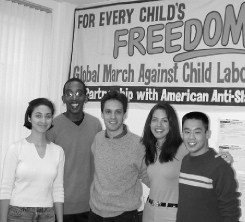 |
| Antislavery advocate Jesse Sage (center) with volunteers (from left) Odette Yousef '03, Jay Williams '03, Erika Abrahamsson '03, and Kenneth Wang '01. |
Sage has focused in particular on AASG's educational efforts, drawing on what he learned about American antislavery traditions and activism in college courses and using the journalism and web-design skills he gained. "Through our web portal, www.iAbolish.com, we can make slavery an immediate issue," he explains. The website posts background information and the stories of slavery survivors; it has also enabled more than 30,000 people to become "e-abolitionists," Sage says, by signing up to receive e-mail alerts that include form letters on slavery issues to be personalized and returned to AASG, which converts the messages into faxes and sends them to the appropriate members of Congress.
Sage also finds himself explaining one of the group's most prominent and controversial activities: its participation in the slave-redemption program, primarily in Sudan, run by Christian Solidarity International (CSI), a human-rights organization in Zurich. Critics have suggested that such a buy-back system perpetuates a vicious cycle. Instead, Sage asserts, slavery in Sudan is not an economic, supply-and-demand matter, but a tactic devised in the 1980s by the mostly Arab-Muslim military government in the north to use against the mostly African, Christian and animist, inhabitants of the south in the country's long civil war. Unpaid militias allied with the government are sent to destroy strategic villages, Sage explains, and the soldiers receive the women and children as booty. In the last four years, AASG has raised more than $150,000 for CSI's program, which Sage reports has freed almost 80,000 people since 1995. The redemption program "isn't a solution to slavery," he emphasizes, "but if I have an opportunity to get people out of slavery, I will take it. Remember that Frederick Douglass escaped from slavery, but his friends still had to buy his freedom to protect him from the Fugitive Slave Act."
His antislavery work, Sage says, has been "both depressing and intellectually stimulating. I fluctuate between being really sad about the whole situation and being inspired by the fact that this work shows how a small group of people can make a huge difference."
~Harriett Green





