
 |
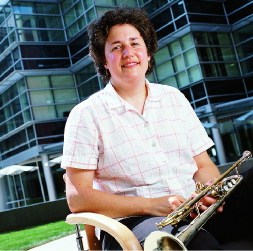
| Laura Justine Garwin |
| Photograph by Stu Rosner |
After trumpeting with Harvard's jazz, concert, and marching bands, the Bach Society Orchestra, and the pit orchestras of many musicals, after volleyball and water polo, and after earning an A.B. in physics, Laura Garwin '77 went to England. She enjoyed the bracing mists and Brussels sprouts for 19 years. First, as a Rhodes Scholar at Oxford, she got a second A.B., in geology. Then, at Cambridge, she added a Ph.D. in earth sciences; her thesis was on fission-track dating and tectonics of the eastern Pyrenees. In 1988 she joined Nature magazine and became physical sciences editor of that illustrious journal. In late 1996 she recrossed the Atlantic to Washington, D.C., to head Nature's North American office; occasionally she was heard on NPR being interviewed about scientific matters. Last September she returned to Harvard as director of research affairs at the new Bauer Center for Genomics Research. A crucial task is to identify and hire scientists as fellows of the interdisciplinary center. Eight fellows are in place, each running a research group of up to three people. Two or three vacancies remain. She and professor Andrew Murray, the center's director, seek physicists, mathematicians, computer scientists, and chemists to join biologists in fathoming the ocean of genomic data now in hand. She sees the fellowship program as a "battering ram" that will assault the walls dividing scientific disciplines. Garwin further hopes to scale some artistic walls this September. She came back to Cambridge last fall just after the audition season for local orchestras had ended. Now she is taking lessons with the first trumpet of the Boston Philharmonic and practicing for the coming auditions, her eyes on a night job with a local ensemble when the new season begins.





