Ever since Chicago mayor Richard M. Daley named Arne Duncan '86 chief executive officer of the city's public schools in June 2001, many Chicagoans have suspected the former Harvard basketball player has the hardest job in town. The school system, after years of abysmal results, was reorganized on a corporate model by the Illinois legislature in 1995 and placed under the mayor's direct control. Even though Duncan was deputy to the previous CEO and had spent six years directing a Chicago nonprofit that developed educational opportunities for children on the city's South Side, his selection surprised most people.
Chicago's public-school system is the third largest in the country and the second largest employer in Illinois. Among other difficulties, its new CEO faced the inevitable inertia of an institution with 45,000 employees and the clashing priorities of many different constituencies. But Duncan has shown he is not afraid to wade in. After less than a year on the job, he announced in April that three of the city's lowest-ranked schools would not reopen in the fall. (Their students will attend other neighborhood schools.) "I don't know if it's ever been done before anywhere in the country," he says, "but we had to stop perpetuating a culture of failure. We're going to open new schools in two of those buildings a year from now with new faculty, with brand-new everything." The program, known as the Chicago Renaissance Schools initiative, was welcomed by parents, but drew a sharp protest from the teachers' union.
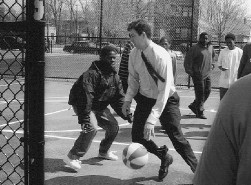 |
| Arne Duncan says basketball helps him relate to students all over Chicago. |
| ©Chicago Sun Times / Brian Jackson 772107 |
Duncan lists such attempts at real change as one of his four top priorities. Literacy, he observes, "is number one and always will be. We have to continue to improve our students' ability to read and write well, and to express their ideas well verbally and on paper. If we do that, we open up the world to them. If we don't, then all the bells and whistles don't mean very much." Recruiting and retaining outstanding teachers is his second goal. "We're looking for great people to make a tremendous commitment," he says bluntly, because Chicago teachers "are definitely underpaid, relative to wealthier school districts." Expanding after-school programs is third: "We're trying to turn all our schools into community centers open from 7 in the morning until 8 or 9 at night. I think one of the reasons test scores have improved so much this year is because 50,000 more students have participated in afternoon enrichment activities. We also have many parents coming to our schools to take [high-school equivalency] classes and English as a second language, and for family counseling. We're convinced that if we engage the parents, there will be benefits for our school children."
If his professional résumé is somewhat short, Duncan points out, "In a way I've been preparing for this job all my life." Growing up in Chicago, he spent afternoons at the tutoring center his mother runs for inner-city children; he also took a year off from college to work at the center as research for his senior thesis. Sociologist William Julius Wilson (then at the University of Chicago, now at Harvard), who read the thesis and found it outstanding, has been a mentor and friend ever since. And all along, Duncan played basketball: he cocaptained the Harvard team and spent four years after college in a professional league in Australia. Now he likes to end visits to public schools in the gym, playing two-on-two games with the pupils. "Basketball helps me go out and relate to kids all over Chicago," he says. "It's been a bridge builder, the way it's been my entire life. Since I was a kid, it's allowed me to travel into neighborhoods and do things most white kids wouldn't dream of doing."
William Julius Wilson says of Duncan's appointment, "He took the position not to further his own career, but because he is truly committed to improving public education. For that reason he is immune to the kinds of pressures experienced by other administrators." Duncan says, "The mayor gave me one mandate when he asked me to take this job: 'Do the right thing by our children.' That's my driving focus. And as long as you keep that at the front of your mind, it makes many tough decisions much easier. I sleep like a baby."