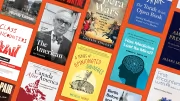
The Complete Fables of Jean de La Fontaine, translated by Norman R. Shapiro ’51, Ph.D. ’58 (University of Illinois, $80 cloth, $25 paper). The Wesleyan professor—who commutes from Cambridge and writes in Adams House—gives in to his La Fontaine addiction. Hence, “No doubt the first to see a camel/Fled from the unfamiliar mammal,” and other delights.
From Higher Aims to Hired Hands: The Social Transformation of American Business Schools and the Unfulfilled Promise of Management as a Profession, by Rakesh Khurana, Ph.D. ’98, associate professor of business administration (Princeton, $35). Management is an institution—but is it a profession like law or medicine? Is the M.B.A. a professional degree, or simply a license to make lots of money? Khurana explores the “delegitimation of managerial authority” and the “abandonment of the professionalization project in business schools,” and asks whether such schools can “take their future success for granted” or are, perhaps, on the verge of “reinvention.”
Tell Borges If You See Him: Tales of Contemporary Somnambulism, by Peter LaSalle ’69 (University of Georgia, $24.95). This third collection of short stories, winner of the Flannery O’Connor Award for Short Fiction, begins familiarly enough: “I was supposed to meet Emily later that night in the old Hayes-Bickford Cafeteria right there on Massachusetts Avenue in Harvard Square…”
Babies by Design: The Ethics of Genetic Choice, by Ronald M. Green, Ph.D. ’73 (Yale, $26). The author, who professes ethics at Dartmouth and advises Advanced Cell Technology on the ethics of stem-cell research, charts a path toward “the responsible introduction of reproductive innovations” emerging from labs.
Planets, Stars, and Galaxies: A Visual Encyclopedia of Our Universe, written and illustrated by David A. Aguilar (National Geographic, $24.95). An almost psychedelic tour of the cosmos, in text, photographs, and illustrations by Aguilar, director of science information at the Harvard-Smithsonian Center for Astrophysics.
The First Campaign: Globalization, the Web, and the Race for the White House, by Garrett M. Graff ’03 (Farrar Straus and Giroux, $24). The author, formerly a Ledecky Undergraduate Fellow at this magazine, posits a 2008 election about, and shaped by, globalization and information technology.
The Short Book, written and illustrated by Zachary Kanin ’05 (Black Dog & Leventhal, $9.95 paper). The height-challenged author, a former Lampoon president, reaches out to others who, like him, deal with their stature every day “and sometimes at night.”
The Modern Element: Essays on Contemporary Poetry, by Adam Kirsch ’97 (Norton, $24.95). Collected critical essays, on subjects ranging from Jorie Graham to Billy Collins, by one of this magazine’s contributing editors; in these pages, he has written most recently about Seamus Heaney and W. H. Auden.