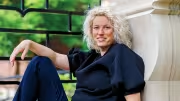
“Three things make us happy,” says Teresita Alvarez-Bjelland ’76, M.B.A. ’79, quoting a CNN report on the topic: “Sex, exercise—and public service.” She plans to focus on public service this year as the new president of the Harvard Alumni Association (HAA). “It makes us feel good to take care of others,” she explains, “and with the Obama administration’s [call for community and national service] and the economic recession, it’s time to give back something of ourselves.” Service is also a unifying cause for alumni, she notes, because it “cuts across all schools and classes and it brings out the best in everyone and can unite us as a University.”
The three HAA directors’ meetings this year will highlight “Harvard’s role in global public service,” she says, and will include a session with keynote speaker Julio Frenk, dean of the Harvard School of Public Health (see “A Global Health View,” March-April, page 48), as well as meetings and events with faculty members from the Graduate School of Education and the Kennedy School. She also hopes to invite undergraduate and graduate students to share their experiences of overseas public-service-related travel and educational ventures supported by Harvard. “I want to share all the wonderful things that are happening through Harvard around the world.”
As a Cuban native who has lived for more than 25 years in Norway (the land of her husband, Christian Bjelland, M.B.A. ’78), Alvarez-Bjelland knows something about cross-cultural community-building and leadership. “I am Hispanic…by birth and by temperament. I am European by marriage, and place of residence,” she told the graduating seniors during her Class Day speech. “But I am very much American by loyalty and gratitude!”
With a professional background in advertising and marketing, the Oslo resident has also spent considerable time and energy volunteering for Norwegian and other nonprofit arts and culture organizations, including the Stavanger-based International Chamber Music Festival, the Norway-American Association, and the Stavanger 2008: European Culture City competition.
Her contributions to the University have spanned more than two decades, ranging from reunion and club activities and admissions interviews (which she began as a Kirkland House tutor in the late 1970s) to various roles on the HAA board, on which she has served since 1995. She received the Radcliffe Distinguished Service Award in 2001, and two years later the College admissions office Hiram Hunn Award for her extensive volunteer work.
“You get involved as a way to give back,” Alvarez-Bjelland explains. “I was grateful from day one with the opportunities I had just being here; this place opened up a whole new world for me.” Even moving to Cambridge was a giant culture shock. The atmosphere was nothing like the warm, tropical lifestyle she had always known with her family. (She says she has never adjusted to the Norwegian climate—and plans to be buried in Miami.) “People have asked me, ‘Did you feel discriminated against?’” she says. “Never. Not once. People were always very nice to me; they went out of their way to be nice. I was the American Dream—this Cuban refugee who made it to Harvard.”
In 1962, Alvarez-Bjelland moved with her family from Cuba to Miami. Talented at math, she soon learned English, rising to the top of her high-school class—the largest senior class in Florida history at the time—and was named valedictorian. Alvarez-Bjelland jokes that she concentrated in “people” at Harvard, “because I like to talk and I’m always talking and meeting new friends.” (In fact, she chose psychology and social relations.) Elected her class’s First Marshal in her senior year, she recalls giving part of her speech in Spanish to honor her father who was in the audience: “Gracias, Papi, por todo lo que tu y Mami han hecho por mí. (“Thanks, Papi, for all you and Mami have done for me”).
After graduating, she spent a year at the London School of Economics, then returned to Harvard for business school. Later she worked in marketing and advertising in Denmark for four years, but ultimately left a full-time job as managing director of Bates Advertising in Norway to be home with her children, Tracy ’08 and Christian ’10 Bjelland. She is currently a freelance consultant, but is glad to focus this year on the HAA and other University activities. “My kids associate Harvard with ‘Mommy being happy,’” she says. “When I got the Hiram Hunn Award, I said, ‘You must be giving me this because you want me to work another 24 years.’ Well, I am still here.”
Her work for Harvard is a form of public service, she says; it’s a way to promote the resonant results of research, scholarship, and the arts. “I am still receiving wonderful inspiration and pride in all the things Harvard is involved with, like stem-cell research—this was so important to do, especially during the Bush administration,” she says. “We should all try to focus on something greater than ourselves. That’s what gives us hope for the future.”