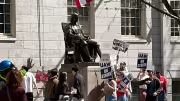
Sunday's New York Times was full of articles with Harvard links. One by Michael Winerip ’74, in the Education Life section, explores ROTC policies at Harvard and other elite universities, and how balancing the ideals of nondiscrimination and national service has these schools “tied up in knots.” (For further reading, see these ROTC-related articles from the Harvard Magazine archives.)
Beren professor of economics N. Gregory Mankiw offered a novel twist on healthcare reform in Washington: Barack Obama may be to liberals what Ronald Reagan was to conservatives—a charismatic leader—but his position on the marginal tax rate is the polar opposite of Reagan's.
The “Corner Office” column had an interview with President Drew Faust, in which she discussed the differences between the role of the university professor and the role of university president, and shared career advice (“Be ready to improvise”).
In the Book Review section, Harvard Magazine contributing editor Adam Kirsch ’97 reviews a new biography of Ayn Rand. For more on Rand, see this article about Rand's Harvard appearance, written by Jennifer Burns ’97, the author of another new Rand book.
And the Times Sunday Magazine had a feature on novelist Orhan Pamuk’s forthcoming museum in Istanbul, inspired by his new novel, The Museum of Innocence. (Or is it the other way around?) Pamuk is a visiting professor at Harvard this year, and Spencer Lenfield ’12, a Ledecky Undergraduate Fellow at Harvard Magazine, brings you coverage of his lectures.
In other venues: the October 30 Boston Globe reviewed ACT UP: Activism, Art, and the AIDS Crisis, 1987-1993, a new exhibit at the Carpenter Center for the Visual Arts. From the current issue of Harvard Magazine, see more images from the exhibit.
Lastly, just for fun: Terry Gross, host of the NPR show Fresh Air, recently had an amusing conversation with Steve Hely ’02, the former president of the Harvard Lampoon and now a writer for the television show 30 Rock, about his new book, How I Became a Famous Novelist, a satirical novel that pokes fun at the world of bestselling books. Listen to the interview and read an excerpt from the book.