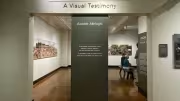
Sassetta's Borgo San Sepolcro altarpiece, reconstructed

Sixty paintings once adorned the altarpiece of a Franciscan church in the small Tuscan town of Borgo San Sepolcro. View illustrations from the modern-day reconstruction.

Sassetta: The Borgo San Sepolcro Altarpiece, a new book edited by art historian and Villa I Tatti fellow Machtelt Israëls, details the reconstruction of a "lost" Italian Renaissance altarpiece. Below, view images from the recent virtual restoration. To read more, see the main article, "Masterpiece Pieces."
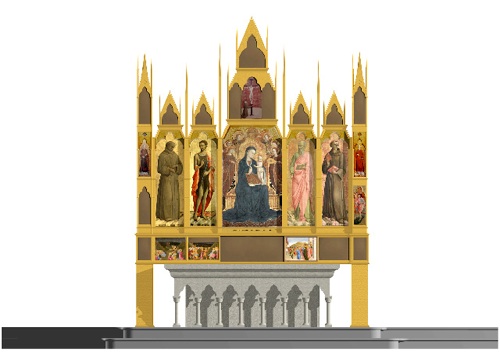
Reconstruction of Sassetta’s Borgo San Sepolcro altarpiece, front view.
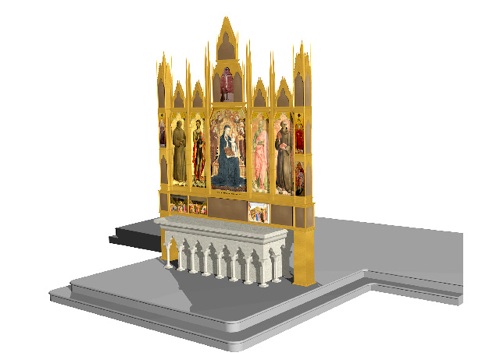
Reconstruction of Sassetta’s Borgo San Sepolcro altarpiece, oblique front view with its full piers, altar, and altar steps.
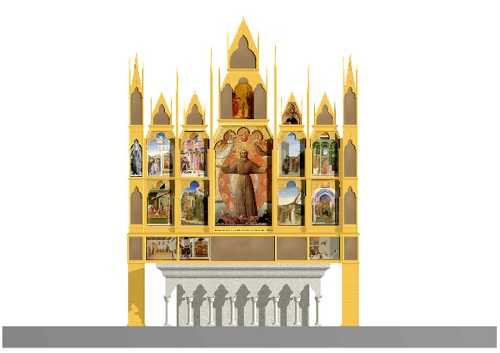
Reconstruction of Sassetta’s Borgo San Sepolcro altarpiece, back view.
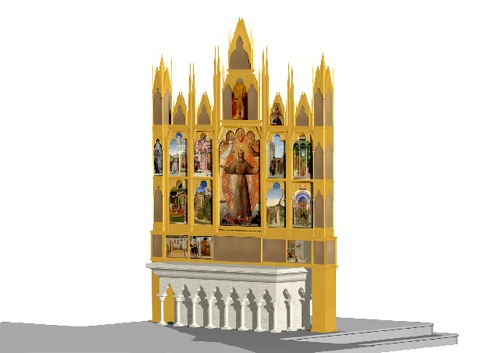
Reconstruction of Sassetta’s Borgo San Sepolcro altarpiece, oblique back view with its full piers, altar, and altar steps.


Credit for all images: Reconstruction by Machtelt Israëls, James R. Banker, Roberto Bellucci, Rachel Billinge, George Bisacca, Ciro Castelli, Cecilia Frosinini, Christa Gardner von Teuffel, Babette Hartwieg, Elisabeth Ravaud, Andrea Santacesaria, Carl Brandon Strehlke, Dominique Thiébaut, Serena Urry et al. Three-dimensional drawing by Andrea Santacesaria, Opificio delle Pietre Dure, Florence. Rendering by Giacomo Tenti, Culturanuova, Arezzo. © Villa I Tatti, The Harvard University Center for Italian Renaissance Studies.
Related topics

You might also like

Tk tk Iran

Artist Azadeh Akhlaghi reconstructs moments of Iranian political upheaval in a series of meticulously staged images.

Science and art capture the microscopic natural world.

Photographer and writer Morgan Smith chronicles life beyond the violence in Ciudad Juárez and other Mexican towns.

Most popular

In her memoir All That's Unseen, Emilee Hackney explores religion, friendship, and home.

A new federal rule sparks uncertainty for graduate students.

China’s Excess Wind Energy

Rather than shutting down turbines, China can harness surplus wind energy to make “green” hydrogen fuel and industrial chemicals.

Explore More From Current Issue

A blue refrigerator covered with animal pictures, notes, and drawings, surrounded by greenery.

An animal’s journey from grief to love shows how much humans need each other, too.

Five individuals are posed in a monochrome outdoor setting near a cinderblock building, some standing, some seated.

Photographer and writer Morgan Smith chronicles life beyond the violence in Ciudad Juárez and other Mexican towns.

Two figures stand before a large, colorful pixelated face against a yellow background.

Harvard scientists identify hundreds of genes under selective pressure.