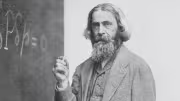
Harvardians on Time 100 list

Three Harvard affiliates have been listed on Time magazine's annual inventory of the world's 100 most influential people.

Time magazine's annual "Time 100" issue, which lists 100 people "who most affect the world" includes three Harvard faculty members. One is Gottlieb professor of law Elizabeth Warren, who chairs the Congressional Oversight Panel investigating the $700-billion Troubled Asset Relief Program (TARP) created to bail out the financial industry. She has argued the case for regulation to make consumer credit safer. A second is associate professor of surgery Atul Gawande, profiled in Harvard Magazine as "The Unlikely Writer."  A third is 1998 Nobel Laureate (economics) Amartya Sen, Lamont University Professor. All three were placed in the "Thinkers" category (the other groups were Leaders, Heroes, and Artists).

In addition, two alumni, Carlton Cuse ’81, producer of the television series Lost, and comic and talk-show host Conan O'Brien ’85, made the list under "Artists." U.S. President Barack Obama, J.D. ’91, appeared among the "Leaders."
 

Related topics

You might also like

These Harvard Mountaineers Braved Denali’s Wall of Ice

John Graham’s Denali Diary documents a dangerous and historic climb.

Rabbi, Drag Queen, Film Star

Sabbath Queen, a new documentary, follows one man’s quest to make Judaism more expansive.

How Stories Help Us Cope with Climate Change

The growing genre of climate fiction offers a way to process reality—and our anxieties.

Most popular

Harvard Professor Michael Sandel Wins Philosophy’s Berggruen Prize

The creator of the popular ‘Justice’ course receives a $1 million award.

The Dark Side of Daylight Saving

Harvard scientists warn against the health effects of abolishing standard time. 

Martin Nowak Placed on Leave a Second Time

Further links to Jeffrey Epstein surface in newly released files

Explore More From Current Issue

Illustration of a person sitting on a large cresting wave, writing, with a sunset and ocean waves in vibrant colors.

How Stories Help Us Cope with Climate Change

The growing genre of climate fiction offers a way to process reality—and our anxieties.

Graduates celebrate joyfully, wearing caps and gowns, with some waving and smiling.

Inside Harvard’s Most Egalitarian School

The Extension School is open to everyone. Expect to work—hard.

A person climbs a curved ladder against a colorful background and four vertical ladders.

Harvard’s Productivity Trap

What happened to doing things for the sake of enjoyment?