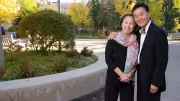
The TIAA-CREF Institute has presented its 2010 Samuelson Award for Outstanding Scholarly Writing on Lifelong Financial Security to Cabot professor of public policy and professor of economics Kenneth S. Rogoff and Carmen M. Reinhart, Weatherstone Senior Fellow at the Peterson Institute for International Economics, coauthors of the best-selling book This Time Is Different: Eight Centuries of Financial Folly.
The award honors the late Nobel Prize laureate Paul A. Samuelson, Ph.D. ’41, LL.D. ’72, for his achievements in the field of economics and his service as a CREF trustee from 1974 to 1985. The Samuelson Award is given annually in recognition of an outstanding research publication containing ideas that the public and private sectors can use to maintain and improve America’s lifelong financial well-being. A $10,000 prize will be shared by the winners.
For more about Rogoff, see these articles from Harvard Magazine’s archives: “After Our Bubble” and “Harvard Economists Discuss the Financial Crisis.”
The Institute also awarded a certificate of excellence this year to the authors of “The Age of Reason: Financial Decisions over the Life Cycle with Implications for Regulation” (Brookings Papers on Economic Activity). The recipients are Sumit Agarwal of the Federal Reserve Bank of Chicago, John C. Driscoll, Ph.D. ’95, of the Federal Reserve Board, Xavier Gabaix, Ph.D. ’99, of New York University, and Goldman professor of economics and Harvard College Professor David Laibson. (For more on Laibson’s work, see “The Marketplace of Perceptions.”) In their paper, the authors “seek to raise a red flag about the increasingly large and complex balance sheets of older adults, who will comprise a growing percentage of the population in the coming decades.”