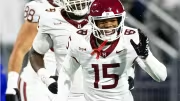
After finishing atop the Ivy League for the third consecutive year, Harvard’s men’s basketball team faces third-seeded New Mexico, the Mountain West conference champs, tonight (March 21) as the number-14 seed in a West Region matchup held in Salt Lake City. The game will be nationally televised, starting at 9:50 P.M. EDT, on the TNT network. This is Harvard’s second consecutive appearance in the NCAA tournament; last year the Crimson, in its first game at the national tourney since 1946, fell to Vanderbilt, 79-70. Harvard has never won an NCAA tournament game.
Naturally, there’ve been some pregame breakdowns. Boston Herald sportswriter Dan Duggan analyzed five aspects of the Harvard-New Mexico game, including three-point shots and rebounding, that the Crimson will need to excel at to upset the Lobos, who boast big men like 7-foot, 250-pound center Alex Kirk and 6-foot-9-inch, 250-pound forward Cameron Bairstow. Harvard’s biggest starter will be 6-foot-8-inch forward Kenyatta Smith ’15, an excellent shot-blocker who will need to add some rebounding, probably the weakest part of Harvard’s game.
Sophomore guard Wesley Saunders, who led the Ivies in scoring, averaging 16.5 points per game, stars on offense and was the focus of a Boston Globe profile that explained the central role that Crimson sophomores have played in building the team’s 19-9 (11-3 Ivy) record this season. An earlier Globe piece profiled freshman point guard Siyani Chambers, who directed the Crimson offense with aplomb and was the Ivy League’s unanimous choice for Rookie of the Year. Both he and Saunders were selected for the all-Ivy First Team; Chambers was the first freshman in league history to receive this honor. He was rarely off the court during Harvard games this season, averaging nearly 38 minutes of play for games that last 40 minutes.
The two coaches, Steve Alford of New Mexico and Harvard’s Tommy Amaker, have their own competitive history, having met as players in the 1987 NCAA tournament, when Alford’s Indiana squad outscored Amaker’s Duke Blue Devils, 88-82. “Just hope I can pay him back,” Amaker said. “I owe him one.” This quote appeared in a piece by the Boston Globe’s Michael Vega, who described the friendly relationship between the two coaches, which also includes nine contests between Michigan, where Amaker coached for six seasons, and Iowa, led by Alford at that time. Iowa won five of those games. But in their one confrontation as players, in that 1987 NCAA match, Amaker outscored Alford, 23 to 18, and played all 40 minutes of his final college game.