1911
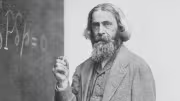
The Bulletin notes that A Lawyer’s Recollections, by George Torrey, A.B. 1859, LL.B. 1861, reveals that in his day the only requirement for an LL.B. was that the candidate enter his name as a student at the Law School and pay his term fees.
1916
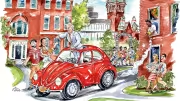
Newly planted elms in the College Yard are restoring greenness to a “blinding wilderness,” observes a Bulletin editorialist, applauding a decision to “check an increasing disturbance of the academic peace” by closing certain roads in the Yard against “the menace and noisiness of the automobile.”
1936
Dedication exercises for the Old Yard’s restored College pump are held, 35 years after it was blown up by a secret undergraduate society, the Med. Fac. Senior College alumnus Henry Munroe Rogers ’62 takes the first drink.
1946
Phi Beta Kappa poet W.H. Auden describes a university in which undergraduates with “nerves that never flinched at slaughter/Are shot to pieces by the shorter/Poems of Donne” and “Professors back from secret missions/Resume their proper eruditions,/Though some regret it.”
1976
The Adams House Raft Race draws more than 25 entries from Harvard, Radcliffe, and Cambridge public schools to the Charles. The Collegium Musicum’s craft finishes first, its crew singing as they paddle. (Many contestants sink early.)
1991
Under a consent decree, all eight Ivy League colleges agree to abandon shared guidelines for undergraduate financial aid, given a Justice Department contention that such cooperation violates antitrust laws.
2001
A 21-day “living-wage” sit-in at Massachusetts Hall, apparently the longest such protest in Harvard history to that date, ends on May 8, after negotiations in which the University agrees to freeze further outsourcing of jobs and accelerate a contract renegotiation with the union for its custodial workers.