A Lens of Love: Reading the Bible in Its World for Our World, by Jonathan L. Walton, Plummer professor of Christian morals and Pusey minister in the Memorial Church (Westminister John Knox Press, $16 paper). If you can’t hear him preach on Sundays, Reverend Walton’s voice is readily accessible this way. “I am an avid reader of the Bible,” he writes simply, because he is professionally, personally, and morally committed to a life “led by our faith, not by our fears.”
Sabina Augusta: An Imperial Journey, by T. Corey Brennan, Ph.D. ’90 (Oxford, $85). A careful excavation of the life and reputation of the wife of the Roman emperor Hadrian—one in a series on women in antiquity—by a professor of classics at Rutgers; working from 200 words of textual references, sculptural representations, and other sources, he effects a remarkable reconstruction of an iconic empress—all the more so given Hadrian’s complicated family and personal life.
The Incomplete Book of Running, by Peter Sagal ’87 (Simon & Schuster, $27). With a half nod to Jim Fixx, the host of NPR’s Wait Wait…Don’t Tell Me applies his voice to his running life, observing that at age 40 (intimations of mortality and all that), “I went from being a person who ran to being a runner.” Unlike his most serious brethren, he can confess, “Sometimes running sucks.”
The Limits of Blame, by Erin I. Kelly, Ph.D. ’95 (Harvard, $35). A professor of philosophy at Tufts addresses head-on the assumptions underlying criminalization of people, sorting out the problem that “the legal criteria of guilt do not match familiar moral criteria for blame.” An atypical philosophical inquiry, with immediate application—to America’s vast system of incarceration.
The Age of Surveillance Capitalism, by Shoshana Zuboff, retired Wilson professor of business administration (PublicAffairs, $38). A daunting, alarmed argument about “the fight for a human future at the new frontier of power” (the subtitle), brought about by technologically enabled capitalism that treats “human experience as free raw material for translation into behavioral data”—and then renders every sphere of life into commerce.
Driving Digital Strategy, by Sunil Gupta, Carter professor of business administration (Harvard Business Review Press, $32). And on the other hand, a nuts-and-bolts guide for businesses about rethinking their strategy, value chain, customer engagement, and organization to succeed in a pervasively digital era.
Globalization and Inequality, by Elhanan Helpman, Stone professor of international trade (Harvard, $26.95). Addressing the literature and technical issues for lay readers, Helpman finds that “rising inequality in recent decades has been predominantly driven by forces other than globalization.” Problems there are, in other words, but choking off the global trade system won’t resolve them.
Wit’s End, by James Geary, deputy curator, the Nieman Foundation for Journalism (W.W. Norton, $23.95). Beginning with the identification of Adam and Eve’s forbidden fruit as a pun (from the Latin malum, meaning both “apple” and “evil”), probes the what, how, and why of wit, seriously but lightly—an apt approach for someone who is also an accomplished juggler.
An Inclusive Academy: Achieving Diversity and Excellence, by Abigail J. Stewart, Ph.D. ’75, and Virginia Valian (MIT, $29,95). Senior professors at the University of Michigan and Hunter College, respectively, comprehensively review the research, and draw on their own experiences, to direct academic institutions toward realizing their aspirations for broadening their faculties.
A Few Thousand Dollars: Sparking Prosperity for Everyone, by Robert E. Friedman ’71 (The New Press, $26.99). The founder of Prosperity Now (formerly the Corporation for Enterprise Development) prescribes universal savings interventions that would enable the most economically marginalized members of society to begin to get a purchase on the levers that lead to an income—and everything that follows in its wake—in a society where the wealth gaps have become impossibly large.
The Promise of Elsewhere, by Brad Leithauser ’75, J.D. ’79 (Knopf, $26.95). The quietly prolific novelist and poet’s seventeenth book: a comic novel about a stuck middle-aged professor at a Midwestern college whose tour of world architectural sites (his field) is deflected by a doomed romance. A journey about yearnings.
The Hell of Good Intentions: America’s Foreign Policy Elite and the Decline of U.S. Primacy, by Stephen M. Walt, Belfer professor of international affairs (Farrar, Straus and Giroux, $28). A critic of both “liberal hegemony” and the present moment of trashing international agreements and organizations willy-nilly, Walt argues for foreign policy guided less by ambition and military prowess and more by the pursuit of peace, exemplary restraint, and the building of alliances.

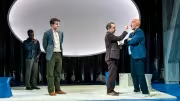
Henry Cobb presenting an early scheme for Place Ville Marie (left) to William Zeckendorf Sr. in 1956—aboard the latter's DC-3
Photograph from the Joseph Molitor Collection, Avery Architectural & Fine Arts Library, Columbia University
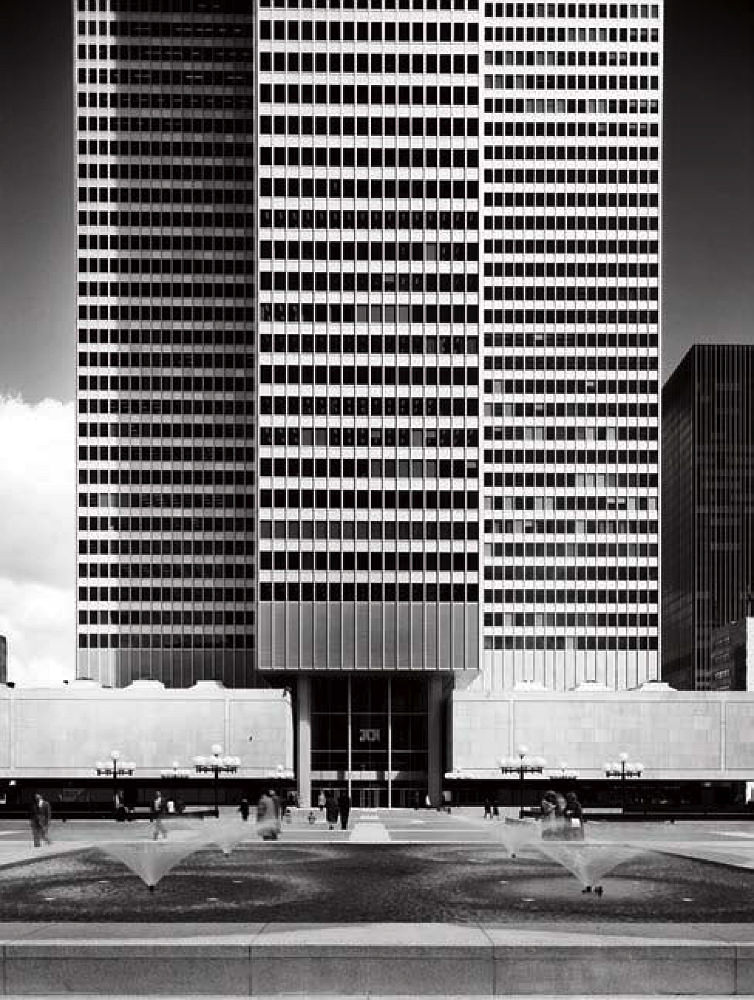
Photograph from the Library of Congress
Words & Works: Scenes from a Life in Architecture, 1948-2018, by Henry N. Cobb ’47, M.Arch. ’49 (The Monacelli Press, $45). The acclaimed architect in his own words. On the Center for Governmental and International Studies, straddling Cambridge Street (represented in handsome photographs here), he gracefully notes of the protracted back-and-forth with Cambridge neighbors and officials, “the extended negotiations and consequent reconsiderations created opportunities that led to improvements in design.”
Peaches Goes It Alone, by Frederick Seidel ’57 (Farrar, Straus and Giroux, $24). New poems by a poet whose work can provoke discomfort (see Adam Kirsch’s “Again, A Dangerous Art,” a review of Poems 1959-2009, November-December 2009, page 19); the publisher categorizes the latest work as adding “new music and menace to Seidel’s masterful body of work.” In the same form, but from a different perspective, Michael H. Levin, J.D. ’69, a lawyer and solar-energy developer, publishes Man Overboard: New and Selected Poems (Finishing Line Press, $14.99); their gentler language often encompasses bracing, current realities, too.