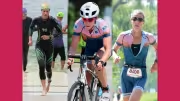
For years Mike Burke, the Faculty of Arts and Sciences’ registrar, had a long and unexceptional daily commute to work from Danvers, Massachusetts. Then one day in 2014, his car broke down. He, his wife, and his two young children were, at least temporarily, now a one-car family. How would he get to his office? The wheels began to turn.
Growing up in Philadelphia, Burke had been a frequent bike rider. In college, he’d gotten used to steep hills while riding through Syracuse, New York, and he’d become accustomed to riding with city traffic during a study-abroad program in London. He had even tried biking around Zimbabwe as a member of the Peace Corps, but after dealing with frequent flat tires, he gave up.
Though he hadn’t done much cycling in decades, he decided he would bike to the local commuter rail station, ride the train to Boston, and then take two subways (or hop on another bike) for the remaining portion. It worked fine, but he was constrained by a variable schedule, stuffed into crowded cars, and subject to weather delays. “And then I decided, you know what, maybe I should just ride the bike the whole way.”
He attached a pannier and waterproof bags to his bike, bought some heavy-duty lights for visibility, and got on his way around sunrise. The most direct route—between 20 and 25 miles—took him through Peabody, Lynn, Revere, Everett, and Charlestown. The trip was hilly and strewn with stoplights, but biking didn’t take any longer than riding a train or slogging through bumper-to-bumper traffic. After posing questions about certain tricky intersections on biking Facebook groups, he developed a less direct but more enjoyable 25- to 30-mile course through Winchester, Lynnfield, Stoneham, Medford, and Arlington—and so committed himself to a three-hour daily round-trip cycle ride.
For four years, almost nothing could spoil his morning trip. Rain was merely a nuisance, and wind and light snow (as long as it didn’t accumulate) were par for the course. Cold wasn’t a deterrent, but sometimes it should have been. One January morning, Burke ventured off in 25-degree weather—manageable with proper layers. By the time he left work that evening, it was dark and below zero with wind chill. “I was like, ‘All right, I’ve ridden in weather like this, it should be okay,’” he recalled. “But I would say probably within the first four or five miles, I realized this was not going to be okay, and I might have to stop.” Not wanting to call his wife for a rescue, he willed his borderline hypothermic body through about 20 more miles, refusing to warm up at the many Dunkin’ Donuts en route out of fear that he would be unable to will himself back onto the bike. By the time he arrived home, he had tunnel vision. He drank hot chocolate his wife had prepared, and his kids lay on top of him, sharing their body heat. After 30 minutes, his body warmed enough to shiver.
In 2018, Burke and his family moved to Pforzheimer House’s Faculty Row, and his trip to work went from 25 miles to about one. He doesn’t miss the time-consuming commute, but he does miss the 50 miles daily, to which he attributes improved health and focus. Now, when his family takes a trip to New Hampshire or Maine, he often opts for a bike—meeting them at their destination later in the day.
In the summer, he gets a chance to recreate his former daily feat, biking from a Gloucester seasonal home to Cambridge on Monday and back on Thursday. At its shortest, it’s about a 35-mile trip one-way, but Burke often takes the scenic route, straying far enough from traffic that he can wear headphones—and extending his pedaling by around 20 miles. “I catch myself singing as I’m riding sometimes,” he said. “Sometimes it’s me and the cows and the horses out there and I’m singing some lyrics from The Clash or something like that.”
Of his attempts to get others to embrace a bike commute, Burke calls himself an “unsuccessful disciple” or a “failed prophet.” It’s hard to convey how a two-wheeled commute can brighten up a day. “The people who get it are the ones who are already doing it,” he said. “I’m working on my kids, though.”