Radcliffe Institute Announces 2021-2022 Fellows

Dean Brown-Nagin emphasizes fellows who will “reckon with this moment and its meaning.”

Photograph of Radcliffe Institute’s Byerly Hall, where fellows meet

Byerly Hall, where the Radcliffe Institute fellows will be able to convene again once fall semester arrives

Photograph courtesy of Radcliffe Institute for Advanced Study.

After a year when the pandemic kept its fellows from convening on campus, the Radcliffe Institute for Advanced Study (RIAS) today unveils its 2021-2022 cohort of fellows: 52 scholars, artists, and others who will, according to Dean Tomiko Brown-Nagin, “reckon with this moment and its meaning.” 

Among the fellows are these Harvard affiliates:

Rebecca Bassett, a graduate student in the Graduate School of Education;

Caroline Buckee, associate professor of epidemiology (public health);

Erica Chenoweth, Stanton professor of the First Amendment (Kennedy School);

Allison Daminger, a graduate student in sociology and social policy;

Elena Leah Glassman, assistant professor of computer science (engineering and applied sciences);

Oliver Hart, Geyser University Professor (economics);

Anthony Abraham Jack, assistant professor of education (Graduate School of Education);

Tiya Miles, professor of history;

Pamela Nwakanma, a graduate student in the government department; and

Sandra Susan Smith, Guggenheim professor of criminal justice (Kennedy School).
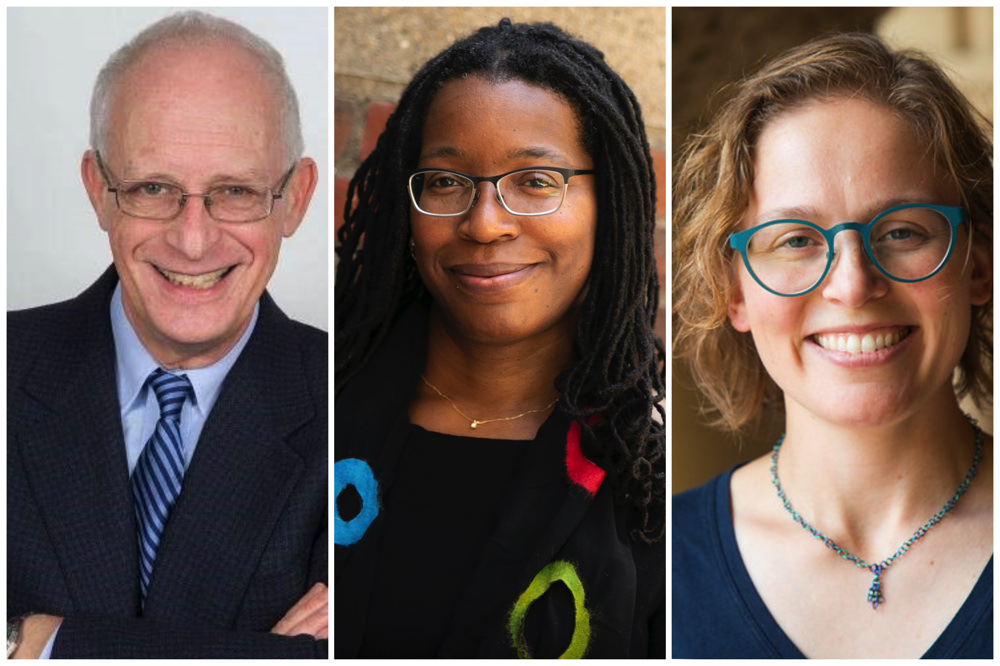

Pictured (left to right): Oliver Hart, Tiya Miles, Elena Glassman.
Oliver Hart photograph courtesy of FAS, Tiya Miles photograph by Stephanie Mitchell/HPAC, Elena Glassman photograph by Eliza Grinnell/SEAS. 

Hart, who shared the 2016 Nobel Prize in economics in 2016, will work on the effectiveness of divestment, boycotts, and other means of influencing corporate behavior, according to the RIAS announcement; other fellows’ projects have not yet been described. Jack is well known for his work on the experiences of first-generation students and those from under-resourced secondary schools at elite, selective colleges and universities. Smith, the subject of the cover profile in the current Harvard Magazine, is a sociologist whose current research involves the effect of jailing on individuals’ subsequent experiences with the justice system.

The announcement and list of fellows appear here.

 

Read more articles by John S. Rosenberg
Related topics

You might also like

Ken Burns on America’s Unfinished Revolution

At Radcliffe, the filmmaker joined Harvard historians to discuss what the nation’s founding means today.

Radcliffe Acquires a Black Feminist’s Archive

An architect of Black women’s studies, Barbara Smith introduced the concepts of “identity politics” and “intersectionality.”

The Harvard and Radcliffe Classes of ’65 Reflect at Reunion

These octogenarians look to the future with hope, and a sense of responsibility.

Most popular

Profile of novelist Yangsze Choo

Malaysian-born Yangsze Choo writes novels infused with the tropical mysteries of her childhood.

Harvard Discloses Top Administrator and Investment Manager Compensation

Investment pay drops—top six managers’ earnings total a little more than $25 million

Harvard Answers Government Admissions Lawsuit

In a separate case, the Trump administration outlines its argument for the federal funding freeze. 

Explore More From Current Issue

Woman in historical dress standing in front of green foliage, smiling brightly.

This Harvard Graduate Brings Women of the Revolution to Life

Historical reenactor Lauren Shear reveals tricks of the trade for playing Tory loyalists, Revolutionary poets, and more.

Historical scene in colonial Boston depicting British soldiers confronting civilians, with smoke rising, in a city street.

Houghton Library Displays Revolution-era News and Propaganda

A new exhibit reveals how early Americans learned about the war.

Colorful illustrated map of Colonial Cambridge and the Harvard College campus featuring buildings of the campus, houses, Cambridge Common, and the Charles River

250 Years Ago, Harvard Was Home to a Revolution

A look at the sights, sounds, and characters that put the University on the frontlines of history