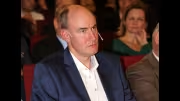
In a letter to the Harvard community this afternoon addressing climate change, President Lawrence S. Bacow described what “Harvard has done and will do to ensure that our community is fully engaged in the critical work ahead.”
The appearance of such a letter was perhaps not surprising in the current global context of wildfires and hurricanes, heatwaves, and deluges and droughts—as well as continued student, faculty, and alumni interest in climate-change research and policy initiatives, and continued advocacy of divesting fossil-fuel assets from the endowment investment portfolio.
Urging action now as “citizens, as scholars, and as an institution to address this crisis on as many fronts as we have at our disposal,” Bacow outlined efforts under way and the beginnings of a path forward. He described a near-total divestment from fossil-fuel investments, as reported last winter, with only legacy holdings totaling less than 2 percent of Harvard Management Company’s (HMC) assets remaining: all through limited partnerships that are now in “runoff mode and will end as these partnerships are liquidated.”
HMC is investing in funds that support a transition to an economy based on renewables, Bacow wrote, while the University has joined MIT in investments in The Engine, a fund focused on, among other objectives, accelerating technologies that could mitigate climate change.
One new element described in Bacow’s letter is the creation of a new post, vice provost for climate and sustainability. “Professor James Stock will work across University boundaries to accelerate and coordinate research and education…to produce crucial new knowledge on climate and sustainability.” Bacow wrote that he had committed “significant resources to seed this effort,” adding that “Harvard must stand among world leaders in addressing this challenge.”
Stock, currently the Burbank professor of political economy, is an innovative thinker in the field of climate-change economics who served on President Obama’s Council of Economic Advisers in 2013 and 2014 (where he worked on plans to reduce carbon dioxide emissions from the electric-power industry). Stock has previously emphasized the importance of establishing the social cost of carbon—putting a price on the economic damage incurred by the burning of fossil fuels. In light of the shifting economics of sustainable power production—wind and solar power has become competitive with, and at times cheaper than, power generated by fossil fuels—he has created a roadmap for decarbonizing the power sector. And in this context of dropping costs for sustainably produced energy, he has pointed out the need for different kinds of policies within different sectors of the economy to swiftly and efficiently effect change. He advocates moving away from the notion of economy-wide carbon pricing to such sectoral policies. In the transportation sector, for example, policies that support reliable electric-vehicle charging capacity at home and work would accelerate the transition to sustainable transportation. Within the scope of his work are both demand-side and supply-side policies: how can policies discourage consumption of fossil fuels (by taxing carbon, for example) and support a path to a sustainable future?
In the announcement of his appointment, earlier this week, Stock mentioned collaborative research on adaptation to and mitigation of climate changes (the effects of which are already becoming increasingly apparent). In a recent interview, President Bacow, using similar language, said, “The work of faculty focused on interventions to adapt to the realities of the climate crisis and mitigate their effects is where Harvard will have its greatest impact.”
Stock is planning to engage with faculty members to assess where the University can make the most significant contributions. “I’m both excited, and humbled, to begin in my work” he said in a statement, “because there is so much opportunity here, for us, together, to make a major impact on climate change.”