Headlines from Harvard’s history

Headlines from Harvard’s history

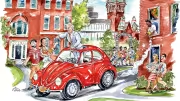
Illustration showing how Harvard Business School settled on its new name in 1961

Illustration by Mark Steele

1921

Barracks and stables are under construction on Soldiers Field to house 20 enlisted men and 85 horses for the department of military science.

1946

As of October 1, a total of 12,183 students have registered for fall term—a third larger than the previous peak—with final business and law school figures yet to come. Housing, especially for the 3,300 married veterans, is a major problem. Among the 5,419 undergraduates, there are 3,858 veterans.

1951

The weekly board fee for undergraduates reaches $14, prompting talks of limiting servings in the dining halls.

1956

Martha May Eliot’s appointment as professor and head of the department of maternal and child health in the Faculty of Public Health makes her Harvard’s third female full professor.

1961

Among alterations proposed for the Harvard School of Business Administration after a two-year study initiated by its dean is a change of name. The Bulletin reports “a widespread feeling” that the present name “does not imply an institution of professional stature, and that there should be…a Harvard Business School.”

1966

Creation of the Institute of Politics—at the renamed John F. Kennedy School of Government—is officially announced at a dinner on October 17, held in the newly completed Holyoke Center and attended by eight members of the Kennedy family.

1971

The Harvard class of ’75 includes the sons of the presidents of Columbia and Yale.

2006

The new Harvard College Women’s Center opens in Canaday Hall, culminating “the efforts of our students for 35 years,” notes dean of the College Benedict Gross. People “had to be pushy as well as smart to make this happen,” adds 300th Anniversary University Professor Laurel Thatcher Ulrich.

 

You might also like

The Woman Who Penned the Case for War

Mercy Otis Warren’s poetry and plays incited the Patriot movement.

The Harvard-Trained Doctor Who Urged a Revolution

Before his heroic death, General Joseph Warren was dubbed “the greatest incendiary in all of America.”

The Framer Who Refused to Sign the Constitution

Harvard’s Elbridge Gerry helped draft the U.S. Constitution, but worried it might create a new monarch.

Most popular

Profile of novelist Yangsze Choo

Malaysian-born Yangsze Choo writes novels infused with the tropical mysteries of her childhood.

Harvard Discloses Top Administrator and Investment Manager Compensation

Investment pay drops—top six managers’ earnings total a little more than $25 million

Harvard Answers Government Admissions Lawsuit

In a separate case, the Trump administration outlines its argument for the federal funding freeze. 

Explore More From Current Issue

Bronze statues of three historical figures under a stylized tree in a softly lit space.

The Costly Choice Native Americans Faced

How the Revolution reshaped indigenous New England

Four stylized magnifying glasses arranged in a gradient background with abstract patterns.

AI Hunts For Stolen Harvard Coins

A museum curator and a computer scientist track down ancient coins taken in a legendary heist.

Portrait of a man with white hair, wearing a black coat, arms crossed, thoughtful expression.

The Framer Who Refused to Sign the Constitution

Harvard’s Elbridge Gerry helped draft the U.S. Constitution, but worried it might create a new monarch.