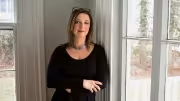
In 1970, when Mary Summers ’70 and three other women’s rights activists—Jane Pincus, Karen Weinstein, and Catha Maslow—made a documentary about illegal abortion, they saw it as an organizing tool for state-by-state legalization efforts. Fifty-two years later, Summers believes it may serve that role again.
Abortion and Women’s Rights 1970 synthesized the stories and experiences of several women and stated that, of the 800,000 abortions performed in that year, only one percent were obtained legally; 300,000 resulted in complications, and between 3,000 and 8,000 resulted in death. This April, the filmmakers re-released the 28-minute documentary, making it available free online; three months later, the Supreme Court overruled Roe v. Wade, the 1973 decision that had legalized abortion throughout the country. Bans went into immediate effect in 12 states, and are pending in several others.
Summers, now a senior fellow in the Fox Leadership Program and lecturer in political science at the University of Pennsylvania, remembers that when she and the others began working on the film, abortion was being debated in the Massachusetts legislature. “And, you know, the only voices were male voices,” she says. At that time, “There was a sense of outrage and, just, rising-up among women.” Many women had undergone abortions, “and for some it was not so terrible…but lots of people had bad experiences; for a lot of women, it was traumatic.” This was a period, Summers adds, “when young married women were getting into women’s groups and discussing all kinds of issues.” One of them was Pincus, co-founder of the Boston Women’s Health Book Collective and an original author of Our Bodies, Ourselves. “And I think she just thought, we need something that tells our stories.”
In the end, that meant not only their own stories—Weinstein was blindfolded in a locked room for her pre-Roe abortion (Summers and Pincus obtained later, legal abortions)—but also the stories of other women, too. “Once the word went out into the women’s networks” that the group was working on a documentary, Summers says, “Jane started receiving tapes from women, just telling their abortion stories.” The filmmakers spent a year working in the MIT film lab (where Pincus’s husband, the documentarian Ed Pincus, was a professor), splicing together audio recordings from seven women, and pairing those stories with black-and-white photos, newsreel footage, and on-camera narration by Summers and the others to create a coherent whole.
The filmmakers, who had been active in the civil rights movement, were also careful, Summers says, to include the perspectives of poor women and women of color, particularly black and Puerto Rican. The final third of the film is an examination of how abortion restrictions—and the white- and male-dominated reproductive healthcare system more broadly—disproportionately harmed marginalized women. The film stated that before Roe, 80 to 90 percent of the those who died from illegal abortions were poor women of color; a 2021 study by researchers at Duke University estimated that a nationwide ban on abortion would increase pregnancy-related deaths overall by 21 percent, and for black women by 33 percent. The film also noted that the maternal mortality rate for black women was four times that of white women in 1970—a gap that has narrowed only somewhat in the decades since, to three times higher.
“We thought it was really, really important to raise the voices of black and Puerto Rican women,” Summers says, and to include the broader context in which the abortion debate was taking place. That context remains important, she adds: for low-income women, especially in states where laws have been chipping away at Roe for years, abortion access has often been out of reach. She notes the connection between issues like abortion and the availability and affordability of child care, medical care, and paid maternal leave. She continues, “I feel pretty strongly that the bigger, broader agenda we started out with,” before activism became so professionalized and focused on single issues, was in some ways more fruitful and expansive. “All the organizing we did back then, everybody was reaching out and organizing their neighbors, holding small group discussions, knocking on doors, organizing larger rallies.”
Both as a political scientist and as an abortion-rights activist, she says, “I think we need a lot more of that spirit of reaching out and organizing our neighbors—and that includes talking to abortion opponents. I think we need to be putting abortion back into a broader context of health care for all and, you know, what are the other things we need for people to have decent lives? It’s not just a question.”