A colleague once faulted Stephen Owen for using the word "flagon" in his translation of a Tang dynasty text. Standard translations parsed the character in question as "cup" and the liquid it held as wine, or sake. But the text at issue describes killing and mayhem. "Do you really think [those warriors] are running around drinking out of little sake cups?" Owen asked his colleague. "These guys drank from huge flagons made of metal"—he has actually seen one—"and sloshed their ale down by the gallon." Owen objects to the old "translation language," partly because it creates a false image of a very effeminate, aged, and weak China, but also because it makes no distinction in language between the "high-sensibility" people and "the guys that ride horses, assassinate people, and drink flagons of ale." Owen carefully incorporates such changes in level and register into his translations. It's the range within the language that he is trying to reproduce, not the mere denotative meanings of the Chinese characters.
Even so, getting from the apparent austerity of a string of Chinese characters to an English sentence of clear meaning can seem more like an act of creation than of translation. "The process of learning Chinese is learning what's natural, what's forced on you in terms of connections, what's probable, and what's a matter of interpretation," says Owen.
In the anthology, he reproduces the Chinese text, with a character-by-character English gloss, of a particularly tricky Tang poem by Wang Wei, "Stopping By the Temple of Incense Massed." (His full-fledged translation follows.) For this magazine, he was kind enough to share, in a running commentary, some of the cultural resonances that he hears when reading and translating the poem.
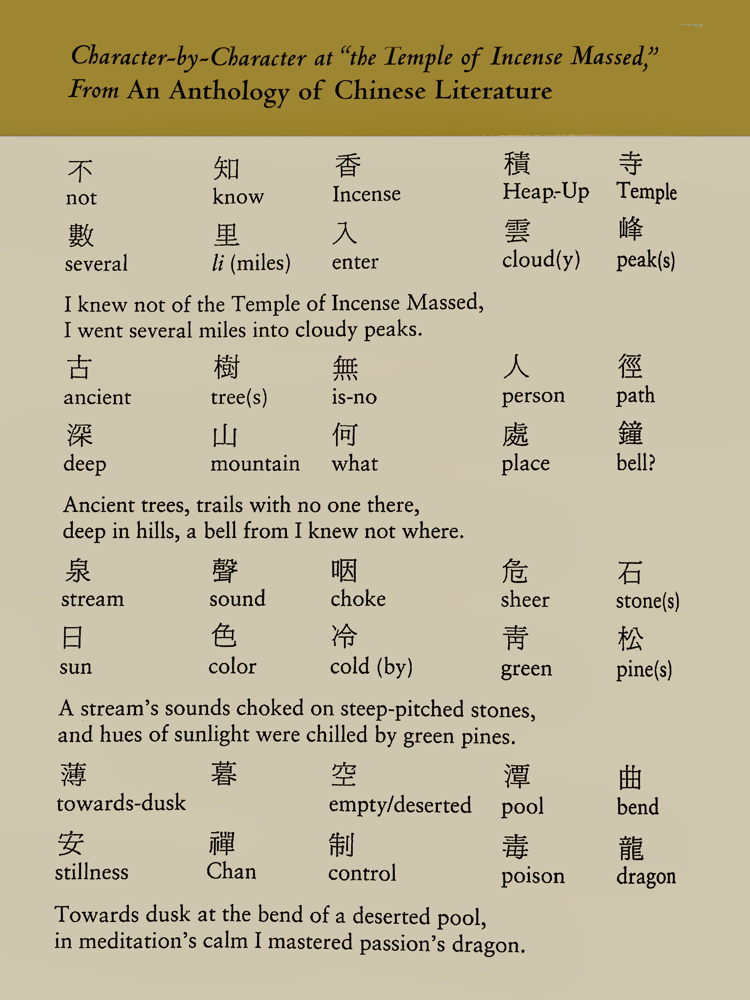
"First you have to realize that, since the poem is titled 'Stopping By,' you assume the poet is speaking, so by convention I can put an 'I' in there."
Not knowing this temple: "The problem is, you don't know whether the poet is saying he doesn't know where the temple is, or if he is even certain the temple exists. Later the sound of the bell tells you that the temple does exist."
He went into the cloudy peaks: "There are nice associations here because you know there's a temple, but you don't know where it is, so you just go into the clouds, 'get lost in the clouds' [Owen's voice takes on a soft, sighing modulation as he invokes the English cliché]. The beauty, of course, is that, being a temple, one of the props is an incense burner and incense burners are made in the shape of mountains which have little cuts in the side where the smoke rises, imitating clouds.
"So far we have, 'I don't know where that temple called Incense-Burner Mountain is and I wonder where it is.' And then you find yourself among the ancient trees. Then you don't know whether there's a path without anyone on it—a no-person path—or simply a path with no human beings on it; maybe there are no human paths, but there are animal paths.
"And then, deep in the mountains at the midpoint of the poem, you hear a bell. The bell means that there is a temple. So you are in the mist, you see a path, and all of a sudden you hear the bell, but you don't know where the bell is coming from. And one of the points of the poem is that you don't ever know where the temple is. The poet has talked about the temple, but it never appears in the poem. And, of course, the temple is quite literally in nature. I mean, there's this booming Buddhist bell, which tells you about the emptiness of all things. And if you didn't know there was a temple, then all of a sudden you are in the landscape and 'boom,' you know there's a temple somewhere. And if instead you didn't know where the temple was, you're lost in this landscape and 'boom'—there's a temple around here but I'm not sure where.
"Then, of course, after the sound of the bell you have the sound of the stream taking its place, so the 'boom'...'boom' attenuates and you hear the sound of rushing water which goes downhill--it doesn't go questing up hills to find temples but follows things, chokes over stones. And [then] there is the sun's color, made cold by green pines—of course, that part is about the passions and the transformations of the passions. And so in this Buddhist environment, as the water comes down, the poet finds himself at the bend toward dusk, at the bend of an empty pool, and this is za-zen, sitting in the stillness of Ch'an [Zen] meditation, controlling the poison dragon.
"So you climb the mountain, there's this boom, the water starts down, the poem ends with a pool as the waters come to a still point. It's getting dark, there's the poet sitting beside the pool in za-zen—Ch'an—meditation. And the poison dragon is the dragon of the passions, like the sun's heat being chilled by the pines; the dragon lives inside and by the stillness of Ch'an you can control it. But also, dragons live in pools, and so you have this vision of growing darkness, the poet sitting here by the surface controlling the dragon, the reflection of the poet in the pond, while underneath the pond, of course, is the dragon, held down by the pond's still surface.
"So there's a lot in that little poem that you might not normally get in translation. You can't get it all, but you've got to start somewhere."