In late March, Danielle Allen, Harvard’s Conant University Professor, spoke at Brigham Young University (BYU) on how to be a “confident pluralist.” The crowd was so large that the event took place in the basketball arena. Students surely were excited to hear Allen speak, but that crowd was not special for BYU. Every Tuesday at 11:05 A.M., students are expected to gather in the arena for a religious devotional or an academic forum (alternating weekly). The school estimates that around 7,000 students attend.
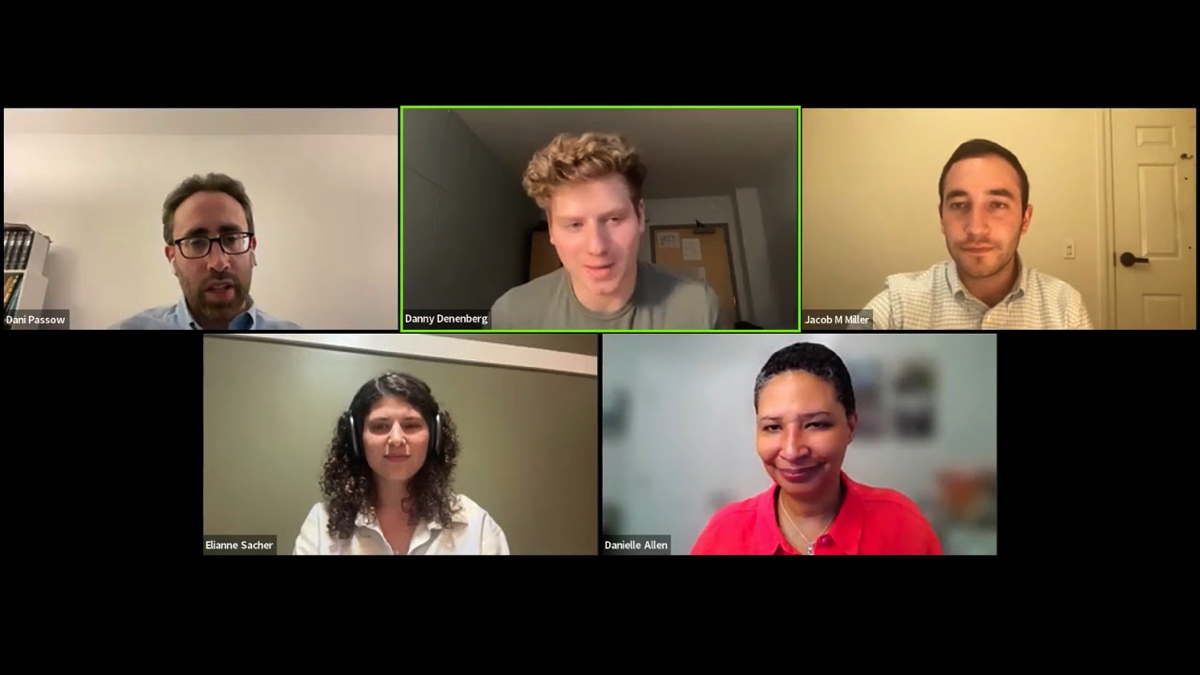
That shared intellectual experience inspired Allen. On May 2, Allen spoke with three undergraduate Jewish students in a virtual event organized by Harvard Hillel, “Negotiating Civil Discourse and Free Speech.” When Jacob Miller ’25 complained about the “lack of dialogue” on campus and blamed the “lack of education” from the University, Allen turned to BYU. Her “fantasy,” she said, is for the University president and provost to preside over a weekly, two-hour session “with the best possible speakers from different sides of the…political and ideological spectrum.” Such a forum, she said, would help establish “a shared intellectual experience” on campus.
Throughout the evening, Allen assessed the administrative chaos that has plagued Harvard this academic year. In the fall, she says, there was a lot of “policy confusion.” Ideally, she said, universities would have clear regulations that protect academic freedom while enforcing “time, manner, and place requirements,” and outlining enforcement mechanisms. But that is not the case at Harvard.
Allen identified two causes for Harvard’s policy instability. The University, she said, is “the most decentralized… in the country.” Different schools have different standards for what constitutes acceptable speech, and nobody is sure what the rules actually are. She blamed the University’s disjointedness, in part, on its lack of a faculty senate. Harvard also suffers from “conceptual instability,” she said. The University is not sure what speech is permissible, and, within that set of permitted speech, which aspects might be “bad” and require “a teaching engagement.”
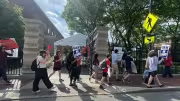
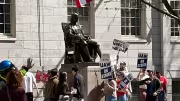
But even when the rules are clear, said Danny Denenberg ’26, students will break them. Denenberg referenced the pro-Palestine encampment, which he said is creating a “hostile space” in Harvard Yard, and whose organizational leaders are “allowed to break the rules time and time again.” Given that other students are publicly flaunting University regulations, he asked why Hillel should “continue following the rules.”
Allen argued that the encampment is “not really about free speech, which is abundantly available: it’s very specifically about civil disobedience.” Though there are “an infinite number of opportunities for speech” on campus, she said, students in the encampment have chosen to “use a method that involves breaking the rules.” Allen reflected on the legacy of civil disobedience, noting that her grandfather helped found one of the first chapters of the NAACP in northern Florida in the 1940s, a group that did sometimes break laws to forward their cause. Civil disobedience, she said, occurs when a group feels as if they have no other choice in their advocacy. “My hope would be that on this campus, we would not put people in the position of feeling that they’ve come to the end of the road in terms of their ability to express important views and make space for necessary conversations.”
Administrators must tread carefully around civil disobedience, she said. The University’s choices “are all hard…there are no good options.” The fact that clear rules have been broken does not mean the University has a simple way of reacting. Administration must balance “a number of different considerations,” she said, “to resolve a situation with minimal harm.”
A third Jewish student, Elianne Sacher ’24, asked Allen why Harvard students are not only “not for conversation, but they reject conversation completely.” Before responding, Allen took time to empathize with Sacher, who shared that some of her family and friends were killed by Hamas on October 7. Allen reflected on a 2017 event when a Harvard undergraduate organization invited controversial conservative political scientist Charles Murray ’65 to speak on campus. Earlier that year, said Allen, “a literal…physical riot” had prevented Murray from speaking at Middlebury College. When Harvard students asked Allen how to treat Murray’s visit, she suggested they run a counter-program, where experts on sociology and race theory would challenge Murray’s findings. That event, she said, was much more educational than simply shouting down a speaker, and it demonstrates that “it’s possible for us to do things differently on this campus.”
For now, the encampment remains in Harvard Yard, and the administration has threatened to place student protesters on involuntary leaves of absence. But there remains a thirst for civil conversation; Rabbi Dani Passow, Harvard Hillel’s senior director of public and alumni programs, said about 400 people tuned into the virtual event. For the complex problems that Harvard and the world face, Allen has no clear answers. “These are hard questions,” she said. “We all need to do some thinking.”