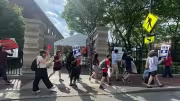
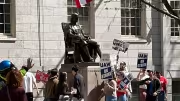
Harvard has conferred degrees on 11 undergraduates who were denied their diplomas on May 23 because they were suspended or placed on probation for violating University standards pertaining to the statement of rights and responsibilities for actions related to the pro-Palestinian encampment in the Old Yard April 24 to May 14, and/or for other infractions (the University does not comment on student discipline, so the exact violations and penalties are not officially disclosed). Those penalties and subsequent events—a Faculty of Arts and Sciences (FAS) vote May 20 objecting to the disciplinary decisions by the College Administrative Board that denied the affected undergraduates (13 in all) the right to graduate, the Corporation’s May 22 finding that the vote did not restore the students to “good standing” and so they could not graduate, and the ensuing protest speeches and walkout at Commencement—are summarized in “Locked In” (July-August, page 17).
The Crimson recently reported that students who had been suspended had their penalties lessened to probation, and those placed on probation had the length of those penalties reduced—presumably as a result of successful appeals. Students who are suspended or placed on probation for more than one term may appeal to FAS’s Faculty Council, which is charged with reviewing Ad Board decisions for any procedural errors, or for any apparent deviation from penalties assigned in other disciplinary cases; the latter may be the situation here.
At least two students posted on social media this morning that they had received their degrees. In a joint Instagram post, Shraddha Joshi ’24 and Asmer Asrar Safi ’24 confirmed the conferral of their degrees: “After relentless student and faculty pressure, Harvard conferred our undergraduate degrees today, three [two] months after the corporation barred us from graduating alongside our peers. We are grateful for the peers and community members who walked out on Commencement, signed and wrote statements, and called on Harvard to listen to its students."
The University released the following statement, without further comment:
Consistent with its May 22 statement, the Harvard Corporation has voted to confer degrees to 11 eligible candidates who have been restored to good standing following the completion of Faculty of Arts and Sciences processes.
The University continues to work to strengthen and improve disciplinary processes, such as the recently announced procedures to enable the work of the University Committee on Rights and Responsibilities to enhance the consistency of investigation and factfinding processes in cases involving more than one school.
Effective, fair, well understood, and consistently applied processes are vital to how we function as a learning community – and how we reconcile the opportunities to express our views, including through protest and dissent, with our obligations to one another.
The changes in disciplinary processes referred to were announced last week: the creation of procedures by which the University Committee on Rights and Responsibilities, formed in 1970 but apparently not active, may investigate the facts surrounding complaints that students from multiple schools violated University rights and responsibilities standards, or that students from one school intruded on the operations of another school. The resulting findings of fact would be referred back to the individual schools for actual disciplinary proceedings. Read a full report and discussion at “Harvard Overhauls Disciplinary Procedures.”