The Early Retirees

The University has disclosed information on the staff members, by school, who were offered and who accepted its voluntary early-retirement incentive program.

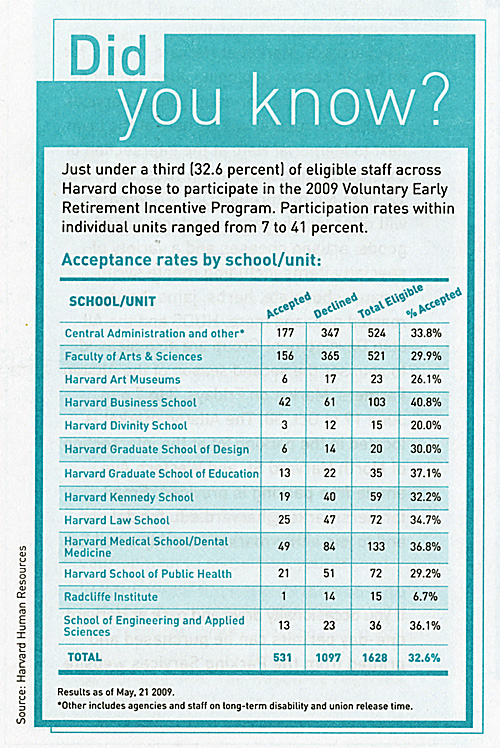
The University has disclosed how many staff members, by school, were offered and accepted the voluntary early-retirement incentive--for those 55 years and older, with 10 or more years of Harvard service--one of the principal cost-saving measures implemented so far. (For background, see here ). The offers were made in two waves, concluded in early May. In all, 531 of 1,628 eligible employees--32.6 percent-accepted.

This exhibit, with data from Harvard Human Resources, was published in the June 2009 issue of the Harvard Resource, the employee newspaper.
 

You might also like

The University will compensate families of those whose remains were sold and establish a scholarship to honor anatomical donors.

After a final round of layoffs, University leaders say 165 staff jobs were eliminated across the division.

Long-discussed reorganization includes layoffs and the end of the Dudley Community.

Most popular

The stakes are high for this husband and wife: one of them will die if they don’t find a cure.

All That’s Unseen charts the Harvard graduate’s uneasy journey from Appalachia to Cambridge and back.  

Harvard Weathers a Year of Turmoil

The federal government has launched unprecedented actions against the University. Here’s a guide.

Explore More From Current Issue

Three actors perform on stage, with one actor interacting closely with another, set against abstract backgrounds.

The play Spare Parts is a contemporary fable about the quest to live forever.

A busy classroom filled with students working at computers, colorful decor, and a bright atmosphere.

In 2004, a frenzy spread across Harvard Yard in days. Four billion users later, we are only just catching up.

Portrait of a man in a denim shirt beside a blue book cover for "Gretal and the Great War" featuring an illustration of a leg holding an army helmet..

The Gretel and the Great War author on how the Lampoon derailed his science career—and set him on a literary path.