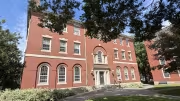
Times Columnist Likes Katz, Goldin Take on Education and Economy

American young adults today have more education than their parents—but the growth rate of educational attainment from one generation to the next has slowed significantly...

New York Times columnist David Brooks likes The Race between Education and Technology, the new book by Allison professor of economics Lawrence F. Katz and Lee professor of economics Claudia Goldin.

American young adults today have more education than their parents—but the growth rate of educational attainment from one generation to the next has slowed significantly. And high-school graduation rates have actually declined since peaking at about 80 percent in the 1960s.

Brooks buys the argument Katz and Goldin make that this educational slowdown is behind widening income inequality and a sluggish economy in today's United States. He writes:

Why did the United States become the leading economic power of the 20th century? The best short answer is that a ferocious belief that people have the power to transform their own lives gave Americans an unparalleled commitment to education, hard work and economic freedom.

Read the rest of Brooks's column here; read more about Katz and Goldin's work in Unequal America, the cover story in the current issue of Harvard Magazine.


Related topics

You might also like

Harvard Law School Announces a New National Security Initiative

The program will focus on the U.S. Congress and the separation of powers in its first year.

FAS Overhaul Brings Deep Cuts to Social Sciences, Phillips Brooks House

After a final round of layoffs, University leaders say 165 staff jobs were eliminated across the division.

Where Should Data Centers Go?

Before a data center is built, Francesca Dominici and Le Xie aim to predict costs to the grid, the air, and the neighbors next door.

Most popular

Trump Administration Will Investigate Alleged Visa Fraud at Harvard

The announcement comes two days after a federal appeals court heard arguments about an international students ban.

Harvard Weathers a Year of Turmoil

The federal government has launched unprecedented actions against the University. Here’s a guide.

Research misconduct by former Harvard professor Marc Hauser reported

Federal investigative agency reports on former Harvard psychology professor’s work

Explore More From Current Issue

A busy classroom filled with students working at computers, colorful decor, and a bright atmosphere.

In 2004, a frenzy spread across Harvard Yard in days. Four billion users later, we are only just catching up.

University Hall with steps and the John Harvard statue, surrounded by trees and a grassy lawn.

Long-discussed reorganization includes layoffs and the end of the Dudley Community.

A flooded office scene with computers, a woman working, and a pink sunset backdrop.

A College student’s attempt to recapture the romanticism of the workplace.