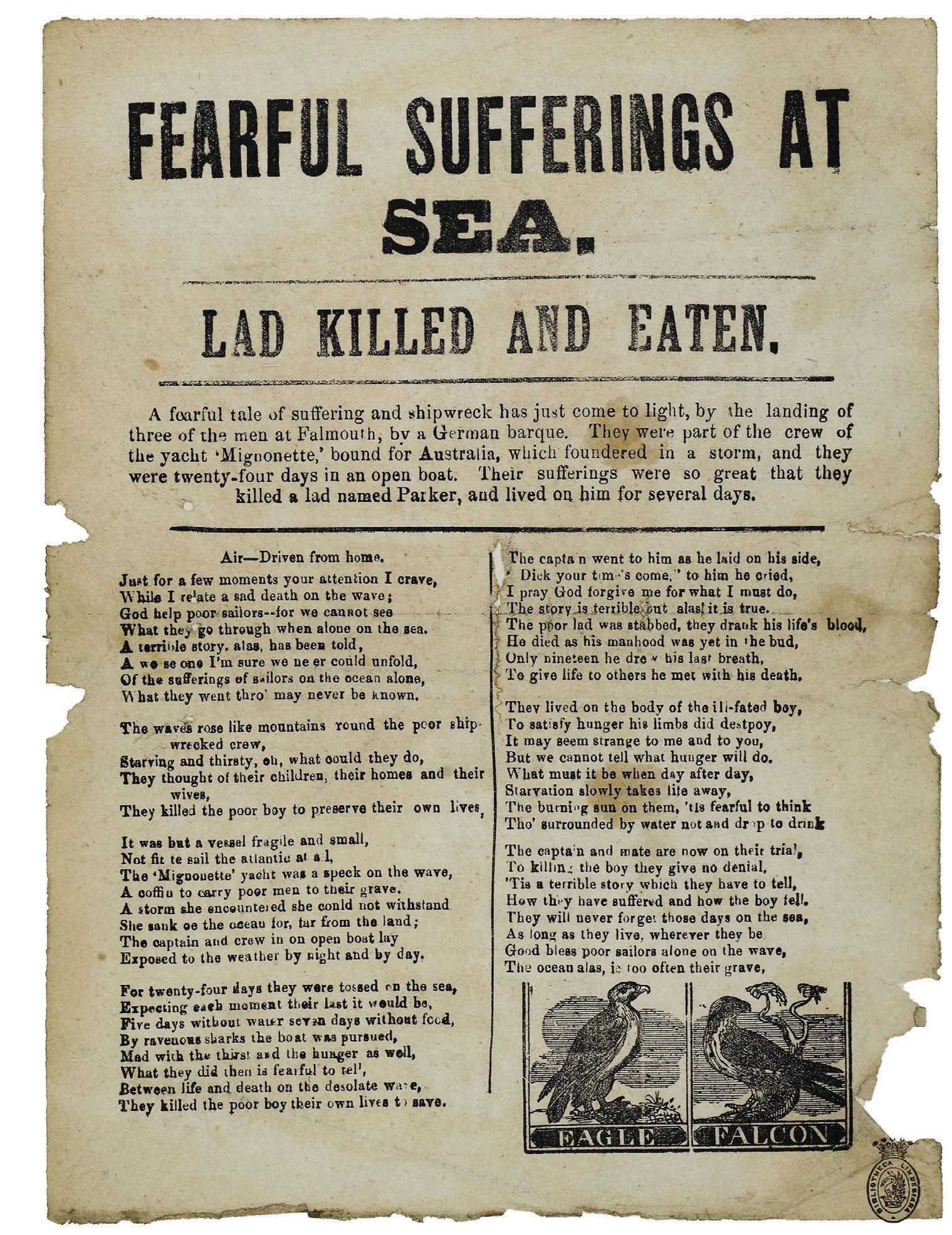
The following poem appears in “The 1884 Cannibalism-at-Sea Case That Still Has Harvard Talking” in the March-April 2026 issue of Harvard Magazine.
Fearful Sufferings at Sea.
Lad Killed and Eaten.
A fearful tale of suffering and shipwreck has just come to light, by the landing of three of the men at Falmouth, by a German barque. They were part of the crew of the yacht ‘Mignonette,’ bound for Australia, which foundered in a storm, and they were twenty-four days in an open boat. Their sufferings were so great that they killed a lad named Parker, and lived on him for several days.
Air—Driven from home.
Just for a few moments your attention I crave,
While I relate a sad death on the wave;
God help poor sailors—for we cannot see
What they go through when alone on the sea.
A terrible story, alas, has been told,
A we se one I’m sure we ne er could unfold,
Of the sufferings of sailors on the ocean alone,
What they went thro’ may never be known.
The waves rose like mountains round the poor shipwrecked crew,
Starving and thirsty, oh, what could they do,
They thought of their children, their homes and their wives,
They killed the poor boy to preserve their own lives,
It was but a vessel fragile and small,
Not fit to sail the atlantic at all,
the ‘Mignouette’ yacht was a speck on the wave,
A coffin to carry poor men to their grave.
A storm she encountered she could not withstand
She sank oe the ocean for, far from the land;
The captain and crew in on open boat lay
Exposed to the weather by night and by day.
For twenty-four days they were tossed on the sea,
Expecting each moment their last it would be,
Five days without water seven days without food,
By ravenous sharks the boat was pursued,
Mad with the thirst and hunger as well,
What they did then is fearful to tell,
Between life and death on the desolate wave,
They killed the poor boy their own lives to save.
The captain went to him as he laid on his side,
‘Dick your time’s come,’ to him he cried,
I pray God forgive me for what I must do,
The story is terrible but alas! it is true.
The poor lad was stabbed, the drank his life’s blood,
He died as a his manhood was yet in the bud,
Only nineteen he drew his last breath,
To give life to others he met with his death.
They lived on the body of the ill-fated boy,
To satisfy hunger his limbs did destroy,
It may seem strange to me and to you,
But we cannot tell what hunger will do.
What must it be when day after day,
Starvation slowly takes life away,
The burning sun on them, ’tis fearful to think
Tho’ surrounded by water not a drop to drink
The captain and mate are now on their trial,
To killing the boy they give no denial,
’Tis a terrible story which they have to tell,
How they have suffered and how the boy fell.
They will never forget those days on the sea,
As long as they live, wherever they be
Good bless poor sailors along on the wave,
The ocean alas, is too often their grave.