
Namwali Serpell is professor of English and an award-winning novelist, essayist, and critic. Although born in Zambia, her economist mother’s home country, her earliest memory, at age two, is of seeing horses for the first time on a misty day in her father’s native England. In Zambia, to which her family returned two and half years later, her first memory is of her fifth birthday party, when her father, a psychologist, threw a snake onto the roof to dispose of it without frightening the other children. At nine, the family moved again, to Baltimore. She recalls being startled to see deer along the highway from the airport—in Zambia, large animals are confined to game parks. She considers each country home, her experiences “syncretic.” After four years at Yale, where she sang a cappella, then six at Harvard as a doctoral student, Serpell in 2008 began teaching at UC Berkeley. She became a U.S. citizen in 2017, when she discovered that by protesting President Donald Trump’s travel ban (which singled out Muslim countries) at the San Francisco airport (federal land), she risked deportation. “Not being able to protest,” she says, “was too much.” In October 2020, when her first novel, The Old Drift, won the Arthur C. Clarke Award for science fiction, that news arrived in the same hour as reports that the police officers who shot Breonna Taylor in her own home wouldn’t be charged with murder. Serpell donated her prize money to provide bail for protesters. Her logic bridged fiction and reality: the novel, which includes narration by an Aeneid-inspired choir of mosquitoes, is an ambitious, unflinching, and deeply allusive “philosophy of error” that she says speaks to this moment in history. Says Serpell, “I’m attuned to justice.”
Namwali Serpell
The professor of English is also a novelist and a critic.

Namwali Serpell | Photograph by Liz Hafalia/San Francisco Chronicle via Getty Images
You might also like

The Year a Beat Poet Squatted at Harvard
In 1954, Gregory Corso moved into Eliot House. How he stayed there is a literary legend.
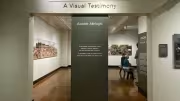
At Harvard’s Peabody Museum, Photos Reimagine Iranian History
Artist Azadeh Akhlaghi reconstructs moments of Iranian political upheaval in a series of meticulously staged images.

Shakespeare and Stephen King Have a Lot in Common
Shakespeare scholar Caroline Bicks studies horror and fear in literature.
Most popular



Explore More From Current Issue

The Harvard triathlete and coach says she helps normal people to “do extraordinary things.”

For advocacy and benevolence, three late alumni are reportedly in line for the Catholic Church’s highest honor.

The outgoing executive director and Harvard Business School graduate went from dancing The Nutcracker to growing a ballet company.