Research Roster

Harvard hums with research. In the fiscal year ended June 30, 2000, the University received $429 million in sponsored-research support...

Harvard hums with research. In the fiscal year ended June 30, 2000, the University received $429 million in sponsored-research support, principally from the federal government. Even that sum is understated: it excludes hundreds of millions more expended at affiliated hospitals, in dozens of endowment-funded research centers, and in the daily activities of humanists whose scholarship often involves only pad, pencil, and library card.
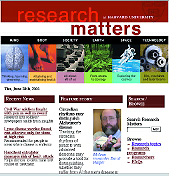
web site home page
web page
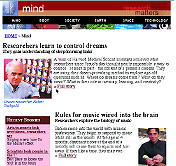
But how does an outsider get a handle on the product of myriad laboratories spread across diverse schools, medical facilities, and interfaculty research programs? Seeking to serve the interests of several lay constituencies, the University's news and public affairs office has created one-stop shopping for the curious with a combined Internet and print channel collectively known as "Research Matters."

The tail is an annual publication, Research Matters, that colorfully highlights recent work in six user-friendly, intuitive categories: mind, body, society, earth, space, and technology. The dog is the accompanying website, www.researchmatters.harvard.edu, updated continuously with synopses of new research, links to the underlying information (including the faculty members doing the work), and thoughtful, easy-to-navigate indexes. Launched in June with several hundred stories, it will quickly grow to encompass thousands.

The aim is to make the researchers' dialogue accessible to government policymakers who control funding, politicians who appropriate the money, journalists, alumni, and students who are tapping current research for school papers. This effort to knit together Harvard sources of research information--and to translate the results into appealing English--may be as ambitious as the research itself.


Most popular

Are ‘Little Red Dots’ Keys to Understanding the Early Universe?

Harvard-Smithsonian astrophysicist Fabio Pacucci explains one of cosmology’s newest mysteries.

Martin Nowak Placed on Leave a Second Time

Further links to Jeffrey Epstein surface in newly released files

Deprivation’s Mark on the Brain

Neglected children’s neurodevelopmental impairments persist into young adulthood.

Explore More From Current Issue

A woman in a black blazer holds a bottle of beer.

Introductions: Mallika Monteiro

A conversation with a beer industry executive

A close-up of a beetle on the textured surface of a cycad cone and cycad cones seen in infrared silhouette.

Research in Brief

Cutting-edge discoveries, distilled

Four Labrador puppies—two black and two yellow—sitting in green grass.

What Do Puppies Know?

Canine capabilities emerge early and continue into adulthood.