At Harvard sporting events, Bill Markus '60 is nearly as ubiquitous as crimson jerseys. For the past two seasons, he's been in the stands for all Harvard's home and away football games, having missed one game apiece in 1999 and 2000. This spring, he showed up at four road-trip baseball games in Florida. His season ticket for hockey got Markus into eight men's games this winter, plus a few women's contests. For the last five years, he has taken in the June Harvard-Yale crew races in New London, Connecticut, riding the observation train when available. Less predictably, he'll also catch some Crimson soccer, basketball, wrestling, fencing, tennis, squash, water polo, softball, volleyball...actually, the shorter list is what he hasn't seen: of Harvard's 41 varsity sports, Markus has turned out for all but golf, skiing, cross-country, and sailing. He accomplishes this despite a rather inconvenient home address: Pittsburgh.
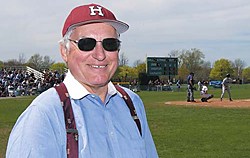 |
| Markus at a home baseball game last spring |
| Photograph by Stu Rosner |
"Not only does Bill go to just about everything," says Varsity Club executive director Bob Glatz '88, "but he can tell you about all the kids on the fieldwhere they went to high school, what they are studying and hope to do after Harvard. He must put in hours reading rosters and media guides. Bill has also become friendly with a lot of the Harvard coaches. There may be a bigger fan somewhere at another institution, but I'll put my money on Bill going head-to-head with anyone."
Markus didn't see a lot of sports in college because he was too busy managing Harvard's lacrosse and indoor track teams. He essayed JV football and baseball, but states unequivocally, "I was horrible. I'm blessed with zero athletic ability." Nonetheless, he did play club lacrosse for 13 years in Pittsburgh, where he chaired the political science department at Duquesne University before taking the reins of a family real-estate business in 1986. In 1988 he began an active volunteer career with the Harvard Alumni Association (HAA); he has not missed any of its thrice-yearly meetings in 15 years.
When in Cambridgeas he was 14 times last yearand several games are in progress, Markus will sometimes "walk around and see an hour of this, half an hour of that." However, he notes, "I'm not a vocal partisan, shouter, or screamer." Away from Cambridge, he checks results "constantly" on the Crimson Sports Line (617-496-1383) and visits the Harvard athletics web page (https://gocrimson.ocsn.com) as well as subscribing to the Crimson and digesting the Varsity Club's News & Views of Harvard Sports. "These [athletes] are real students," he says. "That's why I like Harvard sports so much better than the Ohio States or the professionalsI value the academic aspect."
Other than major and minor league baseball, Markus professes little interest in professional sportshe loves college hockey, for example, but disdains the pro game. "I don't like violence," he explains. In fact, during his scholarly career, Markus examined large-scale violence as part of a lifelong interest in ethnic rivalries and conflicts, a pursuit that has taken him to 97 countries; as a sideline, he speaks on the subject to groups in the Pittsburgh area. "Harvard sports," he says, with a smile, "are a kind of release."
~Craig Lambert