 |
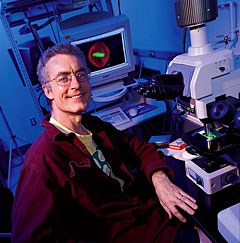
| Timothy Mitchison |
| Photograph by Jim Harrison |
"When I came to America, I found that if you could do something or had something to say, people would listen," says Timothy Mitchison, who as a student in his native England encountered occasional obstacles to doing science. The Sabbagh professor of cell biology at Harvard Medical School has been quietly breaking down barriers ever since. As codirector of the Institute of Chemistry and Cell Biology, he has fostered collaborations among academic chemists and biologists and discovered interesting small moleculesdrug precursors potentially able to cure disease. A founding faculty member of HMS's new, interdisciplinary department of systems biology (see "
Biomedical Momentum"), his abiding interest is in cellshow they move, divide, and control their shape using a system of muscle-like, dynamic protein filaments. He uses a variety of tools to probe cell secrets. Monastrol, a small molecule he discovered that arrests cell division, facilitates his study of the mechanisms of mitosis in frog eggs and human cancer cells. The bacteria listeria (a common cause of food poisoning in processed meats like hot dogs) sheds light on the biochemistry of cell movement, because it "hijacks the mechanism that lets cells move, using it to spread rapidly from cell to cell in the body." When not administering his Harvard lab, Mitchison and his wife, Christine Field, a fellow biologist, are the "activist parents" of two children adopted from China and Cambodia. A word of advice from the father and listeria expert: When cooking franks, "popping them in the microwave is not enough. Rolling boil, four minutes."