
Senior English orator Félix de Rosen ’13 (who in a throat-clearing moment told the Tercentenary Theatre throng, “This feels a little bit different from speaking in section”) chose a graduation chestnut—the passage of time—as his theme, but refreshed it by tying in the story of the late Charles A. Ditmas Jr., long the keeper of the College’s antique clocks. On Wednesday, some Eliot House members of the class of 1963—who as seniors had created one time capsule, exhumed at their twenty-fifth reunion, and buried a second during that event—gathered to examine their 1988 missives. Tony Rossmann, David Otto, Bruce Johnson, and Paul Bamberg opened the capsule at Eliot; missing was Boone Turchi, stuck in traffic. Not all the letters proved prescient, but one did. Also missing was Myles Alexander Walsh III, who died in 2008 (he was represented by his son Myles Alexander Walsh IV, and his son, Myles Alexander Walsh V); he had written, “There is a chance that I will not be able to attend our 50th reunion.” (For more on this story, see www.harvardmag.com/capsule.)
Class of '63 Members Open a Time Capsule
Attending their fiftieth reunion, the "Thundering Herd" reads predictions made in 1988.

From left: David Otto, Bruce Johnson, Xandy Walsh, Alex Walsh, John Fryer, Tony Rossmann, and Paul Bamberg read letters buried in 1988. | Photograph by Jim Harrison
You might also like
Harvard Alumni Win Two 2026 Nobel Prizes
Karl Deisseroth revolutionized neuroscience. Navanethem “Navi” Pillay has adjudicated cases in international courts concerning genocide.
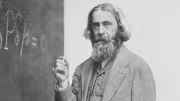
They Might Be (Harvard) Giants
Two tales of University greats—and an encounter with a Tiger
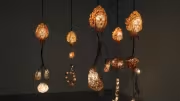
Resculpting an Empire, Through Kitchen Scraps
Artists Enzo Camacho and Ami Lien turn a colonial symbol from Cambodia inside out.
Most popular

Explore More From Current Issue

Artists Enzo Camacho and Ami Lien turn a colonial symbol from Cambodia inside out.

The outgoing executive director and Harvard Business School graduate went from dancing The Nutcracker to growing a ballet company.

Harvard researchers investigate climate’s impact on cocoa crops, innovations in nasal vaccines, and links between pain and skull marrow.