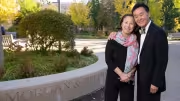
We salute two outstanding contributors to Harvard Magazine for their work on readers’ behalf during 2013, and happily confer on each a $1,000 honorarium.
Art historian Jennifer L. Roberts—Agassiz professor of the humanities and chair of the committee on degrees in American studies—sparked wide discussion with “The Power of Patience” (November-December, page 40), her probing essay on teaching students to decelerate and to immerse themselves in their subjects in pursuit of deep learning. It is fitting that we recognize her work with the Smith-Weld Prize (in memory of A. Calvert Smith ’14, a former secretary to the Governing Boards and executive assistant to President James Bryant Conant, and of Philip S. Weld ’36, a former president of the magazine), which honors thought-provoking writing about Harvard.
Nathan Heller ’06, a past Harvard Magazine Ledecky Undergraduate Fellow, now a staff writer for The New Yorker, crafted a richly reported and wonderfully composed feature on Porter University Professor Helen Vendler’s long collaboration with Arion Press, one of the country’s most distinguished fine-book publishers, in “A Nearly Perfect Book” (September-October, page 34)—the latest of his many excellent articles in these pages. We take special pleasure in awarding him the McCord Writing Prize, named for David T.W. McCord ’21, A.M. ’22, L.H.D. ’56, in recognition of his legendary prose and verse composed for these pages and for the Harvard College Fund.
We warmly thank both.