Even as a young literature student at Harvard, Erin Moore ’98 already yearned to be on the other side of the Atlantic, where the authors she studied lived, breathed, and wrote. In junior year, long before the College institutionalized study-abroad programs, she took a year off, got her first passport, and departed for King’s College London.
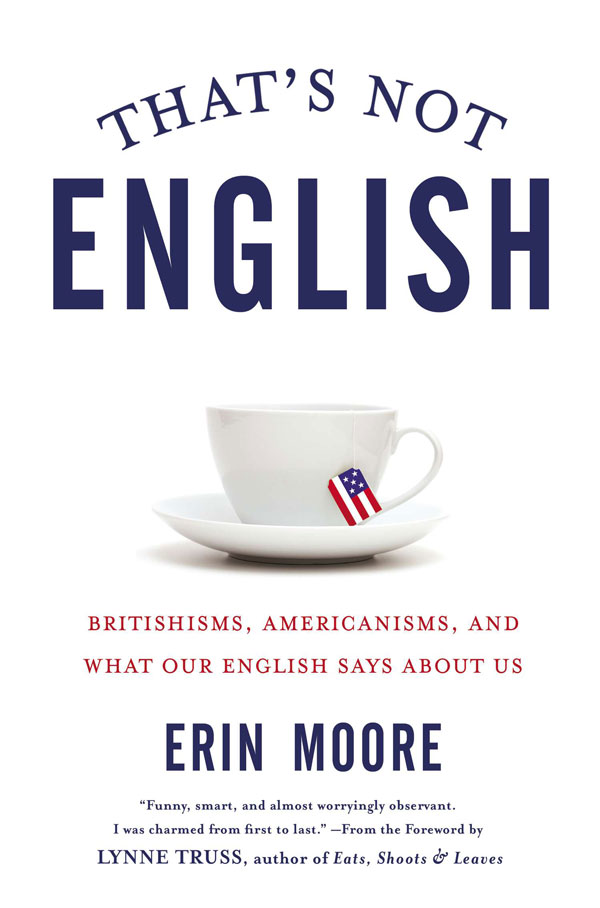
Today, she lives on a busy road in London with her British-American husband, their daughter, Anne, who speaks with a London accent, and their almost year-old son, Henry. Now that her Anglophile dreams have come true, Moore has turned herself into a witty commentator on the cultural and linguistic differences between the British and Americans, all through the lens of her lifelong passion: the English language. In her first book, That’s Not English: Britishisms, Americanisms, and What Our English Says About Us, published in the United States this March, Moore analyzed 30 English words—including “toilet,” “dude,” and “scrappy”—that she thinks shed light on deeper cultural phenomena that setthe two countries apart. Her charming little chapters have earned praise from critics and readers alike: “a bloody gem,” one British reader raved in an Amazon review.
Moore grew up surrounded by oceans in Key West. After college, she moved to New York and worked for 10 years as an editor at Penguin Group USA, sifting through thousands of book proposals to pick out half a percent of real gems. She was paid to read—the dream of an English concentrator. But for the final two years, her job required commuting between London and New York, a lifestyle she grew weary of. Finally, she says, she decided to switch from “midwifing” books to writing them, and moved permanently to London.
“I can’t think of any reason to write a book other than to entertain people,” she declares. The light-hearted tone of That’s Not English belies the research involved: more than a year of combing through books, periodicals, TV shows, and other materials reflective of popular culture. Moore was determined not to write what people in publishing call a “Google book”—one hastily put together through online research. Though the Internet was a useful starting point, she often quickly found herself in the stacks of the British Library, uncovering the source of an idiosyncratic turn of phrase. Her original list of 100 words was gradually whittled down to 30—only those with an intriguing story made the cut. There are personal touches as well: In the chapter on “knackered,” a word with grisly origins frequently used by British parents to mean “exhausted,” Moore recounts her own experience giving birth in her adopted country, where a diaper becomes a “nappy” and a crib becomes a “cot.”
Moore can talk all day about the differences between Brits and Yanks. For one, she says, Americans wear their patriotism on the outside much more than Brits do—“not showing off” is the cornerstone of British culture. But for all her Anglophilia, Moore still admits to being incredibly homesick on July 4. Asked which culture she wants her children to identify with, she can’t choose. “I want them to be aware of the differences,” she replies. “I like the idea that they can grow up to be bilingual in English.”