Headlines from Harvard history

An elephant race, and more from the Harvard Alumni Bulletin and Harvard Magazine

Illustration by Mark Steele

1927

The debating team has won four of six matches during a spring-break tour of the Middle West, the editors note. In each debate, Harvard supported the affirmative side of the question: “Resolved, that the American College is a Failure.”

1952

“Korea—symbol of the undeclared war between East and West—continues to dominate the academic year 1951-52,” with the University “steering a course somewhere between total mobilization and business as usual”; 40 percent of the freshmen are enrolled in the army, navy, and air force ROTC programs.

1962

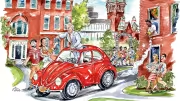
Joseph Russin ’64 guides the four-plus-ton Sonita to a sweepstakes trophy for Harvard at the first Intercollegiate Elephant Race at Orange Coun­ty State College in Fullerton, California.

1972

East Asian studies becomes Harvard’s newest concentration.…Mexican-American and Puerto Rican students schedule a conference to explore problems in implementing a Chicano-Boricua studies program at Harvard.

1997

The Faculty of Arts and Sciences adds a new quantitative reasoning course requirement to the Core Curriculum, replacing the former test-out option. 

Harvard’s first chair devoted exclusively to environmental issues is endowed by Gilbert Butler Jr. ’59 to honor the memory of his father.

More than 300 people gather in the Yard for the unveiling of a plaque on Matthews Hall commemorating Caleb Cheeshahteaumuck, A.B. 1665, and the other four initial Native American students at Harvard’s Indian College.

2002

Following a year of debate and data-gathering, the Faculty of Arts and Sciences makes it easier for undergraduates to study abroad, and more difficult for them to earn academic honors.

Related topics

You might also like

250 Years Ago, Harvard Was Home to a Revolution

A look at the sights, sounds, and characters that put the University on the frontlines of history

The Framer Who Refused to Sign the Constitution

Harvard’s Elbridge Gerry helped draft the U.S. Constitution, but worried it might create a new monarch.

How the American Revolution Freed a Future Abolitionist

Darby Vassall, an enslaved child freed after the Battle of Bunker Hill, dedicated his life to fighting for liberty.

Most popular

How physical appearance influences authority

Cherubic features benefit black male CEOs, but not other groups, underscoring the complexity of social disadvantage.

At Harvard Talk, Retired Supreme Court Justice Breyer Defends Shadow Docket

The current law professor also spoke about affirmative action, partisanship, and the limits of “bright-line rules.”

A Right Way to Teach Reading?

The science, art, and politics of teaching an essential skill

Explore More From Current Issue

Brick archway with a sandy base, surrounded by wooden planks and boxes in a dim space.

How the American Revolution Freed a Future Abolitionist

Darby Vassall, an enslaved child freed after the Battle of Bunker Hill, dedicated his life to fighting for liberty.

Four stylized magnifying glasses arranged in a gradient background with abstract patterns.

AI Hunts For Stolen Harvard Coins

A museum curator and a computer scientist track down ancient coins taken in a legendary heist.

A man holding a revolver and lantern, wearing a hat and coat, appears to be walking cautiously.

Scoundrels, Then and Now

On con men, Mark Twain, and the powers of the Harvard name