It is our privilege to salute four outstanding contributors to Harvard Magazine for their work on our readers’ behalf during 2017, and and to confer on each a $1,000 honorarium.

Michael Zuckerman
Photograph by Leslie Brown
Michael Zuckerman ’10, J.D. ’17—past president of the Harvard Law Review, now clerking for a federal judge in Ohio—combines analytical rigor with unusually fluid prose. We were fortunate to publish “Criminal Injustice” (September-October), his penetrating feature on public-interest lawyer Alec Karakatsanis, J.D. ’08, and are proud to award him the McCord Writing Prize, honoring David T.W. McCord ’21, A.M. ’22, L.H.D. ’56, and his legendary prose and verse, composed for these pages and the Harvard College Fund. We recognized Zuckerman previously, with the Smith-Weld Prize for 2014—a testament to his broad, deep strengths.

Richard D. Kahlenberg
Photograph courtesy of Richard D. Kahlenberg
Richard D. Kahlenberg ’85, J.D. ’89, a senior fellow at The Century Foundation, is recognized nationwide for comprehensive analyses of affirmative action, admissions, and equity in higher education. “Harvard’s Class Gap” (May-June) combined that expertise with personal insight in a feature strongly grounded in the University today. We honor his article with the Smith-Weld Prize (in memory of A. Calvert Smith ’14, a former secretary to the governing boards and executive assistant to President James Bryant Conant, and of Philip S. Weld ’36, a former president of the magazine), which highlights thought-provoking writing about Harvard.

Davide Bonazzi
Photograph courtesy of Davide Bonazzi

Maciek Nabrdalik
Photograph by Wojciech Grzedzinski
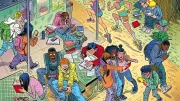
Davide Bonazzi provided exceptionally thoughtful, engaging illustrations to accompany “The Watchers” (January-February), a feature on threats to privacy in the digital era—an unusually challenging assignment that required making tangible the abstract, virtual concepts being reported. And the portfolio of images of refugees, featured in “In Flight” (January-February)—a sampling of the work of Warsaw-based documentary photographer Maciek Nabrdalik, then resident as a Nieman Foundation fellow—remains a haunting record of a continuing humanitarian tragedy. It is a special pleasure to work with such expert, consummate professionals, and to recognize their extraordinary craftsmanship.
The Editors