“We wanted to make something.” Two months ago, as Sharmila Sen and her colleagues at Harvard University Press (HUP), all working from home, followed the news of demonstrations spreading around the country—and around the globe—to protest racism and police brutality, she says they decided they needed to do more than simply issue a statement of solidarity. “We wanted to contribute actively in some way,” says Sen, HUP’s editorial director. “And I happen to be a book-maker, so we made a book.”
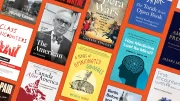
That book, Racism in America: A Reader, was released to the public on Wednesday evening—for free. It is downloadable from the press’s website as a PDF at no charge, and will be available soon from Amazon Kindle and other electronic outlets, also free of charge. A compilation spanning just under 300 pages, it gathers some 20 essays excerpted from HUP-published books—in law, history, sociology, economics, philosophy, medicine, art, literature—that focus on racism. “From the beginning, we had in mind that this book is for students, it’s for teachers, it’s for general readers who are curious as they’re reading news headlines or social media, and they want something with a little bit more depth,” Sen says. “There’s a lot of complexity to these issues, and scholars have been writing about it for decades. We wanted to give something to people looking for a deeper understanding.”
Nearly every excerpted volume was published within the last 20 years (the one exception is Toni Morrison’s Playing in the Dark: Whiteness and the Literary Imagination, from 1992). And the author lineup includes many current and former Harvard scholars: sociologist Anthony Abraham Jack; philosophers Tommie Shelby and Kwame Anthony Appiah; historians Khalil Gibran Muhammad, Walter Johnson, and Elizabeth Hinton; and surgeon Augustus A. White III. Historian Annette Gordon-Reed, named a University Professor earlier this week, provided the book’s foreword: “The United States is, apparently, living through one of those punctuation points in history that, seemingly out of the blue, arrive to spur societal change,” she wrote.
The book focuses primarily on anti-black racism, but also includes voices and stories from other racial perspectives: South Asian, Chinese American, Mexican American, Native American. And although it is available only in digital format, Sen notes, it is designed visually to look like a printed book, with the same attention to art and typography and page layout. “This is a gift,” Sen says. “We wanted it to be beautiful.”