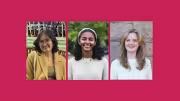
Harvard Magazine welcomed Vivian Rong ’27 to the editorial staff as the 2025 Summer Fellow. From President Alan M. Garber’s Baccalaureate address during Commencement week to a student panel at the end of July, she contributed news and other stories as a full-time member of the staff.
Rong, a philosophy concentrator from Cherry Hill, New Jersey, is an editor-at-large of the Crimson’s magazine, Fifteen Minutes, and the president of the Harvard Undergraduate Creative Writing Collective. In the fall of 2023, she wrote one of the most read Crimson stories of that semester, “The Strange History of Fake Harvard Students.”

This fall, Harvard Magazine will welcome Kate Kaufman ’27 and Andrés Muedano ’27 as the 2025-2026 Berta Greenwald Ledecky Undergraduate Fellows. Starting in the November-December issue, they will alternate as authors of the Undergraduate column and contribute articles about aspects of Harvard life.
Kaufman, a neuroscience and social studies concentrator from Holladay, Utah, is the cultural criticism and columns editor at Fifteen Minutes. Last fall, she coauthored “Viral Veritas,” an investigation of students who earn money as “Harvard influencers” on social media. A former researcher in the Neurospirituality Lab at Brigham and Women’s Hospital, she spent the summer as a “plant humanities” intern at the Harvard-affiliated Dumbarton Oaks Research Library and Collection in Washington, D.C., writing a “plant narrative” about the history of St. John’s wort.
Muedano, an aspiring science journalist from Mexico City, Mexico, is pursuing a self-designed program focused on the environmental humanities and the history and philosophy of science. Muedano writes for the Crimson and the Harvard Undergraduate Research Journal and contributes to the nonprofit news outlet Inside Climate News. This summer he attended Gull Island Institute, an immersive liberal arts program off the Massachusetts coast, where he worked at an oyster farm and studied social theory. He won an Artist Development Fellowship from Harvard’s Office for the Arts to write a fictionalized version of his longform essay “The Scientist.”
The fellowships are supported by Jonathan J. Ledecky ’79, M.B.A. ’83, and named in honor of his late mother. For updates on past Ledecky Fellows and links to their work, see harvardmag.com/ledecky