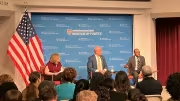
A group of alumni donors has contributed $50 million toward an endowment to fund Ph.D. students in the Faculty of Arts and Sciences (FAS), Edgerly Dean of the Faculty Hopi Hoekstra announced on Tuesday.
The donations—part of a challenge fund to encourage another $50 million in matching gifts—will allow FAS to admit more graduate students across all three FAS academic divisions (science, social science, arts and humanities) as well as in the School of Engineering and Applied Sciences (SEAS). Last fall, FAS had announced that it would cut Ph.D. admission rates in the sciences by half in response to deep uncertainties in federal research funding.
FAS hopes the new initiative, called the Research Accelerator Challenge, will raise $100 million in total by the end of June—enough to endow 50 Ph.D. fellowships in perpetuity. A lead gift from Alfred and Rebecca Lin of the class of 1994, with additional support from Rui Dong ’05 and Thor Johnson, Brian Young ’76 and Anne Young, and others made the effort possible, according to a statement from FAS.
A stable source of funding will enable Ph.D. candidates to pursue the sort of high risk, high reward research that can lead to scientific breakthroughs, without having to depend on federal research grants. The challenge fund will provide comprehensive student support, including tuition, health insurance, and a stipend for five years.
“Graduate student support is a top priority for faculty across our Divisions and SEAS,” Hoekstra wrote in a letter to students and faculty on Tuesday. “This initiative reflects a shift from responding to constraints to investing strategically in our core academic activities.”
Through the Harvard Griffin Graduate School of Arts and Sciences (GSAS), more than 2,500 Ph.D. students currently engage in research and scholarship across FAS and SEAS. The annual stipend for a graduate student increased last year to at least $50,000.
Harvard competes with universities across the world for the best Ph.D. students, chosen not only for the research they conduct but for their future potential to become faculty members. Attracting promising Ph.D. candidates is crucial for retaining and recruiting top faculty, as those students play critical roles in labs and as research partners. Graduate students also play a major role in teaching and advising undergraduates.
Federal grants had been a substantial source of funding for graduate students at universities across the country. But the Trump administration has shattered a decades-long partnership between government and higher education to support scientific research, with a particular focus on Harvard. Last spring, the government terminated more than $2.2 billion in already-awarded grants and contracts to Harvard, citing alleged antisemitism on campus; Harvard sued on First Amendment grounds. A federal judge ordered the administration to restore that funding, but the Trump administration has appealed.
Even if that funding remains intact, the Trump administration could reduce future awards, or impose conditions on funding that universities choose not to follow. The government has also announced its intention to limit “indirect costs,” the negotiated rates that accompany research grants to cover overhead.
Faced with that uncertainty, and citing further budget challenges, FAS last October indicated that the number of Ph.D. candidates admitted in the sciences would drop to just 25 percent of their usual level for two academic cycles. The move met with vociferous protest by faculty members, who pointed to the critical role that Ph.D. students play in teaching and research. Weeks later, after the government had restored its previously terminated grant payments, administrators raised admissions to 50 percent of their prior rate.
In her letter on Tuesday, Hoekstra said “progress on academic planning, more active use of restricted funds, and renewed philanthropic momentum” will allow Harvard to admit more Ph.D. students. FAS and SEAS leaders celebrated the opportunity to increase their ranks.
“Giving our Ph.D. students the freedom to advance the boundaries of knowledge is where truly transformative discoveries happen,” said GSAS Dean Emma Dench. “We want to do all we can to make sure our students remain supported so that they can continue to do extraordinary work.”
“We have Ph.D. students from bioengineering, electrical engineering, applied physics, all within one lab. It’s these incredible Ph.D. students who drive our interdisciplinary research forward,” said David C. Parkes, Paulson Dean of SEAS.
During an open question period at FAS’s monthly Faculty Meeting on Tuesday, professors expressed delight that graduate education would receive this kind of fundraising attention, while at the same time noting that admissions cuts meant the University was missing out on prodigiously talented students.
Hoekstra asked for the faculty’s help promoting the funding challenge program to potential donors.
“The people best able to articulate the value of graduate students are you, the faculty. And bring your Ph.D. students,” she said. “I see you all playing an important role in this effort. We’ll see where the plane lands.”