
After 40 years of scientific and news reports on tobacco's hazards, smoking today may be a fundamentally irrational act. But is it linked with genuine psychological disturbance? Perhaps so, according to a new study that asserts that mentally ill smokers account for nearly half the tobacco market in the United States: 44.3 percent of all cigarettes consumed.
 |
| Graph by Steve Anderson |
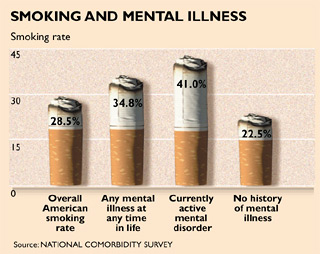
People with psychiatric disorders are almost twice as likely to smoke as others, says Karen Lasser '90, M.D., a research fellow at the Harvard School of Public Health and lead author of a recent study published in the Journal of the American Medical Association. The researchers found that smoking prevalence for people with any history of mental illness was 34.8 percent, and even higher (41 percent) for those with currently active mental disorders. This compares with a rate of 28.5 percent for the general public, and a much lower rate--22.5 percent--for people with no history of mental illness.
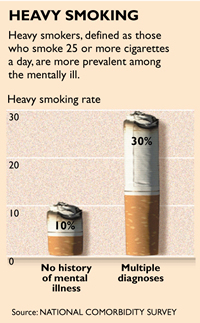
The emotionally distressed also smoke more per day. Heavy smokers, defined as those who consume 25 or more cigarettes daily, show up rarely (10 percent) among persons with no history of mental illness. But that percentage rises with the number of psychiatric problems, reaching 30 percent for those with multiple diagnoses.
The study used the standard definition of mental illness adopted by most psychiatrists in the United States, which includes syndromes such as major depression, panic disorder, schizophrenia, drug or alcohol abuse, post-traumatic stress disorder, agoraphobia, and other psychological disorders. This definition is broad enough to embrace nearly half the U.S. population on a lifetime basis, and to diagnose mental illness in 28 percent of the population within the past month. The numbers appear high because, the researchers explain, the criteria "encompassed a broad spectrum of severity, from simple phobia to schizophrenia."Cigarettes may affect such smokers differently. Tobacco use can, for example, influence the impact of medication taken for psychiatric syndromes. "Smoking increases the metabolism," Lasser points out. "The body gets rid of the drug sooner--washes it out. You have to take higher doses, and that may mean more side effects." Some studies show that mentally ill smokers may experience more "tardive dyskinesia" (involuntary lip-smacking and uncontrolled hand movements), a side effect that is often irreversible, says Lasser.
The researchers also question the presumption that mental illness causes smoking. "We find a high correlation of smoking with mental illness," says Lasser, "but we don't know which is cause and which is effect. Recent studies show that smoking may precede mental illness."
 |
| Graph by Steve Anderson |
One bright spot was a surprising finding about quit rates, which Lasser and her five coauthors expected to be lower among the mentally ill. Instead, the cessation rates for those who stayed away from drugs or alcohol for a year were 39 percent and 41.5 percent respectively--almost the same as the 42.5 percent quit rate for the non-mentally ill. Yet "there is some reluctance in the medical community to encourage the mentally ill to quit," Lasser says. "Caregivers see that cigarettes are one thing that makes people who are so ill feel better. They are not looking at the big picture."





