 |
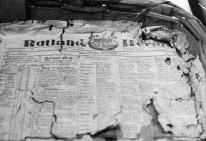
| Conservator Marjorie B. Cohn, with the tools of her trade, meticulously restored the fragile newspapers, shown below in their initial deteriorated condition. |
 |
In her book, Laurel Thatcher Ulrich describes the conservation work undertaken by Marjorie B. Cohn, then the conservator of works of art on paper at the Center for Conservation and Technical Studies at the Fogg Art Museum, and now Weyerhaeuser curator of prints in the Harvard University Art Museums.
She began by taking photographs of the interior to document the exact placement of the papers, then removed and replaced them, backing them with an acid-free lining. The most difficult task was to lift the paper from the basket without creating further damage. Working sheet by sheet, she applied a poultice designed to dissolve the paste underneath the paper without damaging the paper itself. Because early-nineteenth-century paper was made from rags rather than the wood pulp that became common later, it is remarkably tough. The conservator was able to tease the papers off the basket onto a fabric support and then wash them in several changes of hot water, reversing them onto a sheet of Mylar to scrape away any remaining residue. Finally, she lined them with a transparent tissue and reapplied them to the basket in their original order, using the photographs and carefully drawn "map" as her guide.
For the museum conservator, the basket offered both a technical challenge and an opportunity to restore the integrity of an engaging artifact. Like the person who first lined the basket, she was more interested in the fabric of the newspapers than in their content. But in the course of her work, she exposed at least for a moment a fascinating story on the back of the sheet lining the lid. This story connects our basket with a central theme in New England history and folklore, the myth of the disappearing Indian.