A plant of modest beauty and legendary elusiveness, Shortia galacifolia, called Oconee bells or little coltsfoot, is a woodland, evergreen, herbaceous herald of spring, about eight inches high, liking moist shade and native to mountains from Virginia to Georgia. Botanical explorer André Michaux collected an incomplete specimen (leaves, stem, and a single fruit) in the mountains of Carolina in 1787 and took it home to France.
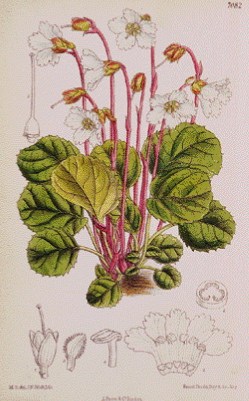 |
| Illustration by John Nugent Fitch, courtesy Arnold Arboretum; photograph by Jim Harrison |
Asa Gray, traveling in Europe, came upon the specimen in the Michaux Herbarium in 1839, subsequently searched for a living plant in the Carolinas, couldn't find one, but described the species technically for science anyway in 1842, naming it for Charles Short, a Kentucky botanist and physician.
Gray became professor of natural history at Harvard and spent decades, as did many plant hunters, in a fruitless search for a living representative of the species. At last it was rediscoveredin North Carolina, by a youngster, accidentally, in 1877, by which time Short had died. Thus, the botanist M.V. O'Gorman observed, the plant was "discovered by a man who didn't name it, named for a man who didn't see it, by someone who didn't know where it was."
In 1886, Charles Sprague Sargent, first director of the Arnold Arboretum, working to help prevent the extinction of the species, found the very locale where Michaux collected the type specimen.
Asa Gray judged Shortia galacifolia "perhaps the most interesting plant in North America" for reasons not quite clear. His fascination with it may have been because its similarity to a Japanese shortia fueled his belief in a preglacial flora that had encircled the globe and seemed to help prove the theories of Charles Darwin, of whom Gray was an enthusiastic supporter.
The illustration is from Curtis's Botanical Magazine, 1889, in the library of the Arnold Arboretum. The plant is rare in the wild, and not the easiest thing to grow in gardens, but it has a following. "Acony Bell" is a musical salute to the flower by the bluegrass duo Gillian Welch and David Rawlings (she shared in this year's Grammy for the soundtrack of O Brother, Where Art Thou?), with words that go in part like this: "Just a simple flower so small and plain/With a pearly hue and a little-known name/But the yellow birds sing when they see it bloom/For they know that spring is coming soon."