Every time a Harvard office hires an architect, designer, or plannerand that happens frequentlyplans and maps and other kinds of information are requested from the University's central planning office, Harvard Planning and Real Estate (HPRE). Data are culled from Harvard's Geographical Information System, which allows information stored in a database to be graphically displayed in layered maps.
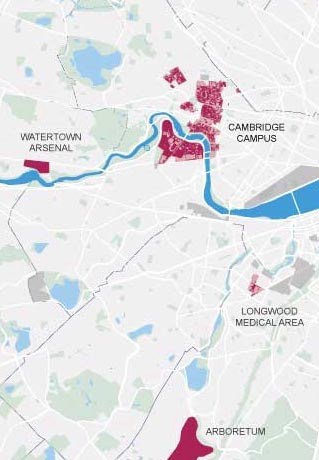 |
| A map of Harvard-owned property, from Harvard Patterns |
With every request, says Kathy Spiegelman, associate vice president for planning and real estate, "We felt as though we were starting from scratch, and University clients for capital planning and projects were paying for the same thing over and over again, and everybody was seeing things from a slightly different point of view depending on what part of campus they were working on." To address that situation, and anticipate the University's physical planning needs for Allston, an interdisciplinary team of HPRE planners and students at the Graduate School of Design created Harvard Patterns, a detailed analysis of Harvard's campuses in Cambridge and Allston. There are sections on building alignment and tree groupings, lighting, use of ornament, building use by night, style, landscape, and historymore than 50 topics in all.
Though intended for design professionals, the document will fascinate anyone with an interest in Harvard's built environment. Harvard Patterns is accessible on-line with any PDF viewer-equipped browser at www.hpre.harvard.edu by clicking "Physical Planning" and then "Harvard Patterns."