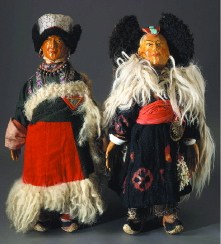
These figures of women, each about 18 inches tall, hail from Ladakh, a region of Kashmir and one of earth's highest places. Wearing traditional Ladahki garb, with plenty of lamb's wool for warmth, they now reside in the Peabody Museum of Archaeology and Ethnology.
 |
| Photograph by Hillel Burger |
Geshe Lobzang Tsetan, a Ladakhi lama on a visit to the Peabody, explained that such figures were made to resemble wealthy individuals in ill health who commissioned the monastery to perform a ritual to remove their maladies. The monks asked the spirit afflicting the patient to bother the model instead. For the scheme to work, the model had to be an accurate, appealing portrayal of the patient. Thus the silver-and-coral necklace, the jeweled ear-hoops, the Indian brocade, the brass and cowrie fertility ornament, the headdress sewn with turquoise. Such figures are still madeas dolls to sell to tourists.
Robert Le Moyne Barrett, A.B. 1898, who in 1902-03 was an associate of the University Museum in geography, spent a year and a half in 1924-25 living in a tent with his wife, Katharine, in various campsites in Baltistan and Ladakh, where they collected these figures. They wrote about their adventures in The Himalayan Letters of Gypsy Davy and Lady Ba, Written on pilgrimage to the high quiet places among the simple people of an old folk tale (1927). Their colorful narrative comes equipped with maps annotated by Gypsy Davy in language such as this: "Upon this High Crag where a Hermit dwelt aforetime did we Abide from the last month of the Water Hog even unto the first month of the Wood Mouse."
The climate of Ladakh is cold and dry, yet the thin air makes the heat of the sun intense. Thus it is said that only in Ladakh can one sit in the sun with one's feet in the shade and suffer sunstroke and frostbite simultaneously. The Barretts did not complain. Lady Ba wrote to a friend on January 12, "You see, we're warm and well-fed. And happy? Content, with a degree of contentment one never would have time to savor in the 'torbellino del mundo,' even if it were obtainable. And here, where we find life utterly desirable, the religion demands renunciation of all desiring."