Summers on Fannie Mae and Freddie Mac

This morning's Wall Street Journal reprints a blog post by Eliot University Professor (and former University president) Lawrence H. Summers. Summers, who served as...

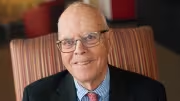
This morning's Wall Street Journal reprints a blog post by Eliot University Professor (and former University president) Lawrence H. Summers. Summers, who served as Secretary of the Treasury from 1999 to 2001, writes that a noble principle—opening up home ownership to a broader swath of the American people—underlay the creation of Fannie Mae and Freddie Mac, but that the regulatory framework and the public were all too willing to look the other way precisely because the entities were founded on a noble principle.

Non-Wall Street Journal subscribers can find the original post here.

More of Summers's thoughts on the U.S. economy will appear in the September-October issue of Harvard Magazine.

Related topics

You might also like

Making Waves with Philosophy

A conversation with Harvard professor Michael Sandel

For Campus Speech, Civility is a Cultural Practice

A former Harvard College dean reviews Princeton President Christopher Eisgruber’s book Terms of Respect.

Your Views on Conservatism on Campus, Doxxing, and More

Readers write in about international students at Harvard, the September-October cover, and changes at the Chan School of Public Health.

Most popular

250 Years Ago, Harvard Was Home to a Revolution

A look at the sights, sounds, and characters that put the University on the frontlines of history

When the Revolution Hit Cambridge, Harvard Moved to Concord

College students broke hearts and windows during their year in exile.

The Harvard-Trained Doctor Who Urged a Revolution

Before his heroic death, General Joseph Warren was dubbed “the greatest incendiary in all of America.”

Explore More From Current Issue

Brick archway with a sandy base, surrounded by wooden planks and boxes in a dim space.

How the American Revolution Freed a Future Abolitionist

Darby Vassall, an enslaved child freed after the Battle of Bunker Hill, dedicated his life to fighting for liberty.

Historical scene depicting a parade with soldiers and a town square in the background.

When the Revolution Hit Cambridge, Harvard Moved to Concord

College students broke hearts and windows during their year in exile.

A man holding a revolver and lantern, wearing a hat and coat, appears to be walking cautiously.

Scoundrels, Then and Now

On con men, Mark Twain, and the powers of the Harvard name