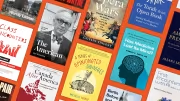
The Case for Big Government, by Jeff Madrick, M.B.A. ’71 (Princeton, $22.95). The editor of Challenge argues that “active and sizable government has been essential to growth and prosperity,” in a book that anticipated recent headlines.
Wired for War, by P. W. Singer, Ph.D. ’01 (Penguin, $27.95). Those drones over Afghanistan and Pakistan, says the Brookings Institution senior fellow, are but the leading edge of robotic conflict in the twenty-first century.
Postcards from Tomorrow Square, by James Fallows ’70 (Vintage, $14.95 paper). Collected dispatches by Atlantic Monthly’s man in Shanghai and Beijing. An excellent shoe-leather reporter, Fallows accessibly covers Chinese manufacturers, Macau’s gambling boom, and the country’s massive hoard of dollars.
The Crisis of the Twelfth Century, by Thomas N. Bisson, Lea professor of medieval history emeritus (Princeton, $39.50). Amid collapsed leadership and governance, threats to social order and peace, new approaches to power and legitimacy arose. A sweeping scholarly history of Western Christendom.
The Piano Teacher, by Janice Y. K. Lee ’94 (Viking, $25.95). A debut novel of “romance, secrecy, and betrayal,” as the publisher puts it, in World War II and a decade later, set in Hong Kong, where the author (formerly of Elle and Mirabella magazines) was born and now lives.
Still Jewish, by Keren R. McGinity, A.L.M. ’97 (New York University, $39.95). A multigenerational history of women and intermarriage in America.
More Than Just Race, by William Julius Wilson, Geyser University Professor (W.W. Norton, $24.95). Wilson’s latest installment in a career-long investigation of ghettos, low-skilled black men, and the fragmentation of African-American families—and of the changes needed to alter the status quo.
All Other Nights, by Dara Horn ’99 (W.W. Norton, $24.95). A different sort of Civil War romance, this novel begins with Jacob Rappaport planning a poisoning at Passover in New Orleans.
The Scientific Life, by Steven Shapin, Ford professor of the history of science (Chicago, $29). A densely reasoned examination of the moral life of scientists and why it matters, as they practice in the academy, within corporations, and as entrepreneurs in pursuit of riches.

Quality time: Rainy Day with Dream Blocks (1908), by Jessie Wilcox Smith
Enchanted Hunters: The Power of Stories in Childhood, by Maria Tatar, Loeb professor of Germanic languages and literatures and of folklore and mythology (W.W. Norton, $26.95). More exploration of children and reading, as previously reported in “The Horror and the Beauty” (November-December 2007, page 36).
China between Empires, by Mark Edward Lewis, JF ’86 (Harvard, $29.95). A Stanford scholar on the formative pre-Buddhist period of the Northern and Southern dynasties.