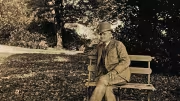
Gary King, Florence professor of government, and Marc W. Kirschner, Walter professor of systems biology, have been named University Professors, Harvard’s most distinguished faculty position. King, founder and director of the Institute for Quantitative Social Science (www.iq.harvard.edu, and see “Putting the Science in Social Sciences,” September-October 2001, page 71), becomes the Weatherhead University Professor, succeeding the late Samuel P. Huntington. Kirschner, founding chair of Harvard Medical School’s (HMS) department of systems biology and previously of the department of cell biology, becomes Enders University Professor, succeeding Nobel laureate David Hubel, now emeritus. (For background on Kirschner’s work, refer to “Seeing Biological Systems Whole,” March-April 2005, page 67, and the review of his recent book on the mechanisms of evolution, November-December 2005, page 22.)
University Professorships, created in 1935, are intended to recognize especially distinguished faculty members whose research crosses the conventional boundaries of departments and disciplines. There are now 22 such professorships.
King, who joined the Harvard faculty in 1987, has done so through quantitative studies probing fields from voting behavior and international conflict to the proper design of survey instruments (see the Harvard at Home video series at https://athome.harvard.edu/programs/vsr).
Kirschner’s work on cell division, embryo development, and the evolutionary ori-gins of the nervous system has led him to draw on biology, computer science, physics, engineering, and other disciplines—-all encompassed in the nascent systems biology department and its associated Ph.D. program. He joined HMS from the University of California, San Francisco, in 1993. For information on his laboratory, see https://kirschner.med.harvard.edu.